Tuesday, November 24, 2015

Diversity or Individuality: Pick One

Diversity can be useful in some instances (such as higher education and genetic variation to name some of the few) but in almost every sphere of human life, diversity is subversive to community and is directly harmful to individual identity.

A community is a unified body of people.  To have a community, there must be something common to unite it.  Unity is created when people share things:  The things that create the strongest unity are the same things that give people their individual identity, The things, in general, are what we call culture.  The things which make up a culture, include, but are not limited to, religion (the sense of the sacred, ritual practice, and faith-tradition), memory (temporal-spatial  and emotional experiences, traditional customs, and local and genealogical history), and values (ethical conduct, moral principles, life-goals, the arts, and leisure in general).  It is not a community which gives the individual his identity, but neither is a community dependent on individuality:  Culture creates both individual identity and community.  The individual alone cannot create a culture, he needs to be part of a community in order to become immersed in its culture.  The community, however, cannot maintain a culture without the active participation of its individual members.  Individuality and community are mutually dependent:  You cannot have one without the other.

Diversity is the property of having different elements or qualities in a thing.  Diversity is, by definition, contrary to community.  A “diverse community” is an oxymoron.  A community needs a cohesive culture to make it a community.  There can be small niche cultures, such as a “gaming culture,” a “baseball culture,” a “rock-and-roll culture,” etc. effectively making even smaller communities possible (e.g. the “Warcraft community”) but these are extremely limited and superficial notions of community.  When one typically speaks of community in general, the whole extent of religion, memory, and values is evoked.  If a given group of people do not share the same religion, the same memory, or the same values; if they have vastly different backgrounds, perspectives, life-goals, and moral principles, than it is no community.  One can effectively distinguish communities by pointing out cultural differences between them.

Because you cannot have an individual without community, diversity effectively dissolves individuality.  It creates a fragmentation of culture and so weakens the bond between the individual and the community from which he learns his identity.

There is indeed such a thing as healthy diversity, e.g. a larger state composed of diverse communities, and there is unhealthy diversity, viz. no community at all, on account of the lack of unity between persons within a given area.  Any given state can have a multitude of different communities, each with its own unique culture.  When diversity is promoted within a community, that community begins to dissolve.  

Wednesday, September 23, 2015

Why the Government Needs the 1%


Imagine two island nations with the same population and resources. Each one has 1,000 citizens and a surplus equaling $1,000,000 per year.
 
On Island A, 1% of the population owns 90% of the surplus.  This means that 10 citizens own $900,000.  Put another way, each rich citizen makes on average $90,000 per year.  The 99,000 citizens own $100,000 of the annual surplus, meaning that each poor citizen makes on average $1.10 per year.
 
On Island B, the surplus is distributed equally.  This means that each citizen makes $1,000 per year.

On Island A, people pay taxes depending on their tax bracket.  The rich citizens pay 50% of their income in taxes.  This means that, for each rich citizen, $45,000 goes to the government and $45,000 stays in their bank account.  Each poor citizen pays just under 10%, meaning that they each give the government 10¢ and keep $1.  All together, the government of Island A makes $459,000 per year.
 
If the government of Island B is to make the same amount as Island A’s government, it would have to tax each citizen 46% of their total income.  This means that one who makes $1,000 on Island B would be taxed in the same bracket as one who makes $900,000 on Island A.
 
The government of Island B would not be able to tax 46% of its nation’s wealth without inciting a revolution, but the government of Island A taxes 46% of its nation’s wealth with no problem at all.  Island A’s government makes more money than Island B could ever make because of economic inequality.
 
If Island B’s government wants to make as much as Island A’s, it has to do one thing; raise taxes.  They must do it slowly, because you can’t take $500 away from someone with $1,000 without making that person very upset.  Right now, Island B taxes 10%, taking $100 from each citizen, leaving each with $900, making its government’s revenue $100,000.  If it raised the taxes to 15% (perhaps pointing to some public crisis as a justification) it would make $150,000, but something else would happen.  It would hurt its citizens.  Each person would only keep $850, which means each person would probably try to make that up in some way:  They might spend less, but most likely they will find a way to stretch their money.  For example, instead of going without cookies, they will find cheaper cookies.  Another way it would affect people depends on how they relate to their income.  If the citizens of Island B are mostly self-employed, the extra 5% tax will cause some to produce and sell more, some to cut corners and produce more cheaply, and some to lower their standard of living.
 
When the economy of Island B rocks slightly then stabilizes after the increased tax, it does it again, raising taxes from 15% to 20%.  What a serial (and ever so slight) increase in taxes will do is to pressure its citizens into changing their behavior and seeking alternatives to economic security (because their government is making their income less secure by the year).  Citizens will find ways to make more money for themselves at the expense of other citizens.  When its economy becomes too imbalanced, Island B will be forced to adopt a “fairer” form of taxation and, before long, its government will be as rich as government A’s, laughing all the way to the bank with its richer citizens.


Wednesday, September 9, 2015

Andy and The Emptiness of Social Justice, Part II: Soft Slavery

     After all his thought, Andy has come upon a stunning realization about ownership and the widespread lack thereof.  There are some basic points which sum up Andy's incapacity to make the difference he thought he could.

1. He is completely dependent on others for everything.

The clear and simple truth about needs is this:  No matter how much money one has, he still gets what he needs from someone else.  Money does not equate to wealth.  Production equates to wealth:  If one has the ability to produce what he needs, it does not matter whether he has money or not, and so long as he can produce what people need, people will give him money for it.  If Andy gives money to the poor and needy, their problems might subside for a little while, but because they are unable to produce anything at all, they will continue to be needy, if not for food, shelter, and clothing then for money to buy food, shelter, and clothing.  What follows from this is that the vast majority of people are needy.  They need someone to give them what they need and they have nothing to trade for it except labor.  A few lucky people might be able to make money without working (just like Andy could by investing his new fortune) but he knows very well that not everyone can do this.  Most people have to work because things need to be produced (and because workers need money), but most people do not produce anything.  "How can this be?" he wonders.  Why is it that most people work but those same people are dependent on others for everything they have, especially the things they need, like food, shelter, and clothing?

2. Others will give him what he needs only out of kindness or obligation.

Everything Andy owns has either come to him as a gift or as an exchange for something else.  He knows that people will be needy so long as they depend on the kindness of others (which usually does not go far).  If he or anyone else is to have any degree of economic security, they cannot simply be charity recipients. Yet the only other way he can get anything at all is by convincing someone that he owes him.  Andy could do this by giving someone money, which is agreed to be worth so much of whatever he wants in return.  Andy has a lot of money currently, but the money he has will be used on consumable things, which means that he will eventually run out of money.  And how does he get more money?  He gets more money by working... for someone else.  The fact about trading is that not only does he get everything he needs from someone else, he even gets his money from someone else.  Before he can trade money for things, he must trade work for money.  This means that before Andy can even think about receiving the things that he wants, he has to find someone to work for.

3. The only thing he can trade is labor.

It is quite obvious that the only thing of value which Andy has to trade is his labor, though his labor has absolutely no value on its own.  In order for his work to be valuable, someone else must decide how he should work, when he should work, and where he should work.  Andy does not really own his own labor:  Before he is hired anywhere, it is understood that whatever his work accomplishes does not belong to him at all.  He has absolutely no say in what to do with his own labor, let alone what to do with the results of his labor.  In exchange for labor, Andy will be paid in money, but he will probably have no say whatsoever in how much money his labor is worth.  If, for example, Andy gets a job making baseball bats, he will not decide what time of day to make bats; he will not decide what shape to make each bat or what color to paint it; he will not decide how much time to spend on each bat; he will not own any of the bats he makes; he will not decide how much each bat is worth; and he will not be paid based on how many bats he makes or how well he makes them, but on how much his manager thinks he should be paid.

4. He does not really own anything.

The fact that Andy does not even own his own labor makes his fifty million dollars seem like an odd puzzle.  Does he not own fifty million dollars?  Well, if by "own" we really mean "can use it however he wants," then no.  If by "own" we mean "nobody can take it away," then no.  If by "own" we mean "can hold it in his hands for a while" then yes, he owns fifty million dollars.  This is how people "own" things.  If Andy buys a beach house and a Lamborghini on credit, then the banks really own those things until he pays them off.  Andy has enough money to buy those things with cash, but even if they are bought and paid for in full, he must still pay to "own" them.  He will still have to pay taxes in proportion to the value of his property.  If he does not pay these taxes, those things will be taken away from him.  Also, depending on the state or town his lives in, there will be many restrictions on how he uses his property, from zoning laws which restrict what the property can be used for to local ordinances which could prohibit anything from cutting down trees to raising livestock.  Thus, not only must he pay to keep his property, he can only use his property in ways others allow him to.

5. It is impossible for him to own anything.

Andy would like to give the poor and needy the ability to be producers, to make what they need and keep it, to acquire basic necessities and to avoid having these things squandered or taken from them.  The hard but simple truth, however, is that not even Andy can have this.  There is no way, not even with fifty million dollars, that he can permanently set himself up with food, shelter, clothing, or any other needs or wants; not because those things get used up, but because he has no way of securing those things for himself.  If he bought a plot of land, built a house, planted a farm, and sewed himself new pants every year, he would still lack two major elements needed for a decent life; security and community.

He would lack security because his land and his house is ultimately State domain:  If he does not continue to pay money to the State for the use of his own "property," the State will reclaim his property. If he uses his property in a way not approved by the State, the state will punish him accordingly.  He would neither be assured to keep his property nor would he have free reign over it.  In short, the only thing "property" is sure to mean is that somewhere there is a piece of paper that associates his name with it.

He would lack community because he could not effectively feed or house or clothe himself without the help of others.  It would be easy to get help if others were trying to do the same thing as him (that is, to really own something) but food and housing and clothing are generally only available from people who want money.  It might be possible for Andy to grow everything he needs to eat and to maintain a house by himself, but that would leave him at a severe disadvantage in the quality of his life, which would easily be remedied if he focused on producing perhaps one or two things he needs instead of everything:  After all, being completely self-sufficient would likely be a hard and lonely life.  Even a self-sufficient man needs community.

If he became a producer of something he could enter the market as a real owner and be able to trade something valuable in place of servile labor.  But community implies a spirit of solidarity in which each member aims to protect the interests of every other member; not out of kindness or obligation, but out of mutual respect.  This community is generally lacking among the few people who actually own things.  In fact, the market is not a community at all, but an arena, a place of fierce competition where the success of one producer is precariously balanced with the potential failure of another.  Andy might be able to become a formidable competitor with a fifty million dollar business, but his goal is not to compete and to win, but to enter into a community and reduce need out of mere appreciation for men.  But because community is almost non-existent, the more people Andy makes producers the less they will be able to compete.

So Andy seems to be left with two options.  Either he tries to make himself an owner, albeit tentatively, and help the market deprive people of property, or subject himself to a soft slavery, in which he is "free" to offer his labor for an arbitrary price so that he can buy what is put in front of him and use things as he is allowed to.

Wednesday, August 12, 2015

Andy and The Emptiness of Social Justice, Part I: What Fifty Million Dollars Can Teach You

Andy is a sociology major.  He wants to do good.  He cares about social justice and dreams of finding a solution for societal problems, such as drug addiction and homelessness.

For his birthday, one year, Andy receives a lottery ticket as a gift.  He is hesitant, but politely accepts and finds, to his bewilderment, that it is a winning ticket.

Well, what a surprise...
Andy is now the not-so-proud recipient of $50 million, compiled through crushed hopes and desperate irresponsibility.  His friends suggest buying a Lamborghini and a beach house and his family recommends investing in biotech, yet Andy knows that, in order to balance the scales of justice, he must find a way to use this stroke of fortune to help those in need.

Tempting...
He realizes, contrary to his friends’ fantasies, that spending a limited sum of money on luxuries will ultimately result in losing both his money and his luxuries.  Due to taxes, insurance, and the inevitable amount of upkeep a mansion and a sports car would require, it would take not only a gigantic but a continuous flow of income to maintain such a lifestyle. Money is fluid, his parents tell him.

His parents’ advice is to find a way for his money to make money:  That is, if he wants to keep his fortune, he must find a way to produce a fortune.  With so much money, they say, it should be easy enough to invest it in ways that will at least maintain his wealth for the future.  Andy is a thoughtful young man, and this advice strikes him as practical, but ultimately self-serving.  He decides to conjure up a plan to use the money in a way that will benefit mankind, beyond himself, yet in a way that will last like any wise investment.

He considers a few ideas that he has entertained, in the past as only daydreams, yet now very much within his reach: 

He imagines that, were he simply to give away his whole fortune to the poor and needy, it would flow away even more quickly than if it were to be poured into a garage full of Lamborghinis; not because the poor are principally irresponsible, but because money is gone once it is spent.  $50 million could feed an entire country for a year, maybe five years, then it would be gone, and both he and the poor would be back where they started.


Perhaps, he reasons, he could build schools and start scholarships and fund free education.  Perhaps, he reasons, he reasons too much, because the schools he would build would be to empower their students.  Knowledge indeed is power, and the investment he would put into it would likely remain stable, but what kind of power is it?  Education would improve lives by providing skills which would increase chances of employment but, without the opportunity for employment, skills are useless.  He himself is educated and were it not for the grim indifference of luck, he would still be working a part-time job for which he is quite over-qualified.  Education seemed like a noble cause at first, but Andy would like to do more than create candidates for unemployment.
 
Model Employees
If education empowers, but is useless without opportunity, he must create opportunity, he thinks.  But how does one do that?  The needy are in need of a living; the poor are poor not because there is want of charity, but because they cannot support themselves.  Andy is convinced that the answer must be to create jobs.  This is a very difficult problem and he is beginning to understand why nobody else has solved the issue of poverty yet.  To create employment effectively, he must become an employer, he decides.  To become an employer, he must secure a labor-based income for his employees; to do that involves business and production.  The more Andy tries to figure out how to help people, the more his thoughts become entwined in schemes very far from his initial ideas. 


Happy little workers, working happily...
He does not want to believe that creating a business is the surest way to help those in need.  Businesses create value, but they do not generate money.  When a business makes a profit, it is because it takes in more money than its products are worth:  What is an income to one is an expenditure to another.  To create a business would only add one more competitor to the market and might ultimately disadvantage as many people as it would help. 

This much is only speculation, Andy realizes, but he discovers that, when it comes to business in general, some things are certain.  One is that the most successful businesses merely supply what is in high demand and that actually producing those things are, in practice, secondary to making a profit from them.  He also realizes that demand is not often the same as need:  The things we need, like food and clothing, are actually quite common and cheap, whereas the things we demand (i.e. want and pay for) are usually more expensive and hence encourage much business to supply.  If business is the answer, then in order to benefit those who cannot produce what they need, he must supply what others demand, so that he can turn the needy unemployed into employed demanders.

To Andy, this seems to be counter-intuitive, and his suspicion is that it seems counter-intuitive because it is counter-productive.  Why would it not be possible simply to let people produce what they need?  Why could he not somehow turn the needy directly into producers?  Perhaps, he thinks, he should figure out what it is exactly that people need.  He does not think it fair to strive only for the survival of the needy; he wants to encourage a decent quality of life for them as well.  There is certainly a global spectrum of poverty, which ranges from starving expatriates to dispossessed addicts, and even fifty million dollars will not be able to help them all.  Andy begins to become depressed by the thought of a sound fortune with nothing to spend it on.  He decides that five of those dollars can go towards a beer and he makes his way to the local pub.

Later at the pub, Andy beholds a striking revelation as he leaves a fiver on the bar in exchange for his frosty beverage.  He had not even thought of the transaction before he made it, but his new net worth has put transactions in a new light for him; he himself has no way of getting anything, whatever the need or demand, without paying for it.  He could buy virtually whatever he wants, but he still has to buy it.  Why?

Socialism: "You work, we'll decide what you need."
Andy goes for a long walk to mull over this question.  Certainly money makes getting things very easy, so long as one has money, but this is a problem for those who do not have money:  The things that one needs are almost always made for the specific purpose of selling them.  So, if one has no money, he cannot get what he needs.  His last five-dollar purchase has made Andy realize that not even he, with all of his money, can change the way this works.  Necessities cost money, which one makes through employment.  He thinks of a type of employment in which employees are given necessities directly as compensation, but this seems very disagreeable to him, almost like slavery.  Money creates a convenient flexibility of purpose; the choice of what one buys is up to the one who buys it and employers do not have to decide for their employees what they should or should not have.  Of course, employers could not give their employees anything but money anyway, because whatever an employer supplies or produces is usually not a necessity, as Andy has already noticed.  So, he figures that standard employment works best as a money cycle:  Each business sells things to its customers and gives a share of the money to its employees. 


In this money cycle, though, each kind of poverty finds its own kind of problem.  He could fly into some famine-stricken third-world village and hand out hundred-dollar bills, but the money would be useless in a place where there is nothing to buy.  He could approach the homeless in any industrialized city and hand out hundred-dollar bills, but they would likely not spend that money wisely.  He could go to either place, address the people’s needs, and buy things for them, but there are already organizations which do precisely that.  It seems to become more clear to him, but Andy feels that tapping into a money cycle is quite a roundabout way of promoting social justice.  After all his thinking, he is convinced that people should be able to produce what they need, even if the world is too complicated to let that happen now.

When beach houses don't seem like a problem...

As far as what they need, he knows that rations and a tent do not lift a man out of poverty.  He now knows too, however, that three square meals and an apartment do not make a man rich, and neither does a Lamborghini and a beach house.  He knows which of these he would prefer to have, but fifty million dollars have convinced him that the value of money is not relative (as he used to think) but arbitrary.  Money only goes as far as those who want it; that is, it is only good for buying things, but what he buys and why he buys it is up to him and, then again, sometimes it is not.  He has no control over what his money means, just as the poor have no control over what their lack of money means.  If he wants to liberate the poor (and himself) he must liberate them from that which makes them poor; and it is not money.  It is the inability to produce what they need:  It is their absolute dependence on others to supply them with what they need for a price which others determine.


Thursday, May 14, 2015

Thoughts on Marriage

It is most likely that the ancient Athenian men, who made no qualms about enjoying sexual intimacy with their male companions, would have thought that the prospect of marriage between two men was not rude or immoral, but useless, impractical, and thus absurd.  Even in their comedies, the idea of exclusively male marriage was not even present as a joke:  It seems that the thought never entered one’s mind, let alone the public forum. 

Marriage, as far as its human origin is concerned, seemed chiefly to concern the establishment and transmission of property, i.e. the protection of one’s exclusive right to a woman (for the sake of children) and the protection of the children’s rights to their father’s property after his death.

Even as women gained value and distinction in the public sphere, their rights eventually equaling those of men (at least in the western world), marriage persisted as the assurance of the security of the family, being a social and legal safeguard for both the exclusive relationship between the spouses and the custody and property rights parents held with their children.

Marriage has a natural definition because it is naturally practical.  This is clear considering the physical dispositions of men and women and the process of child-bearing. 

Marriage has a social definition because it is socially practical.  Women’s rights are proportionate to men’s responsibilities.  If a man has no responsibility to care for his children or the mother of his children, the woman assumes the double (and near impossible) task of bearing and rearing her children as well as supporting herself.  Without loyalty to a spouse, however, the man’s responsibilities are moot:  A woman’s promiscuity diminishes a man’s obligation insofar as they are uncertain of his fatherhood.  Also, even if both parents are present and responsible to their children, their property is prone to loss or theft (by neighbor or by ruler) when there is no clear heir by virtue of some socially recognized bond.

Many movements throughout recent history gradually diminished the definition of the family, which in turn diminished the apparent need for marriage.  Industry grew bigger and more complex, decreasing the natural practicalities of marriage. Man’s role changed from household steward to travelling money-maker.  The most damaging effect on the social understanding of marriage was the gradual cultural displacement of family provider with family money-maker.  Woman’s role has changed as well, from nurturer, housekeeper, and teacher, to secondary money-maker.  Public institutions provide education in lieu of prudential child-rearing.  Commerce thrives on replacing the creativity of wife-and-mothers with affordable household necessities.  Women have been made “free” from their household duties so that they can join men in leaving their homes and earning money to pay for the replacements of their household duties.  If a woman has children without a husband to provide, publicly funded institutions will take his place until the children themselves are absorbed by institutions and the woman becomes provider.

Marriage is today, in its natural form, unnecessary and often even impractical.  This is the reason why marriage has been socially and legally redefined to include unions between two men or two women.  There is no longer a clear definition (or even a need for a definition) of a family.  What remains are social and legal utilities (like property rights and taxes) which, for the present, adhere to two people only in official record; a record which can be dashed and rewritten at whim.  Eventually, even the need to define heirs and co-owners will fade as social structures evolve.  Yet, long before this happens, it will inevitably occur to the public at large that there is no reason why private property can only be shared with one other individual or that, if any two people can be arbitrarily granted custody over a child, there is no reason why any three or four people cannot be granted custody over a child.

Perhaps it be Marxist of me to see such a linear evolution of societal customs (and to evolve does not mean to get better), but the trend is apparent.  The old form of marriage is quickly becoming a thing that is not so much dependent on political bias or economic class as it is on a desired way of life; one which is so far removed from conventional culture that it has an almost isolating effect on those who live it.  It is not inconceivable to think that a day will come when the more conspicuous members of our society will regard marriage as something unthinkable; something useless, impractical, and absurd.


Saturday, May 9, 2015

Tragedy

Tragedy is not mere suffering, sadness, melancholia, depression, misfortune, grief, pain, or loss.  Suffering is an evil; it is not beautiful.  No evil is beautiful.  Pain, sickness, death, loss, misfortune, strife, betrayal, and grief are all evil. They are, in themselves, ugly.

Tragedy involves all of these things, but tragedy is beautiful.

Tragedy is beautiful because love is beautiful.

Tragedy and love are mutually inclusive.

There is no tragedy without love.  There is no love without tragedy.

Tragedy is the beauty which subsists in the presence of ugliness. It is the good which is present amidst great evil.  It is the truth which cannot be crowded out by lies.  No state of events can properly be called a “tragedy” unless its present and defining love is true enough to outlive its opposing evil.

Evil is synonymous with a lack of beauty, a lack of goodness, and a lack of truth.  The evil we experience in tragedy only reveals – exaggerates – the kernel of truth, beauty, and goodness intrinsic to love.  The evil characteristic of tragedy is a darkness which serves to amplify our experience of a light too subtle to notice under mundane circumstances.

Every relationship we have with what is beautiful and good is haunted by the mortality of the object’s beauty.  Whatever is beautiful and good in our experience can be crushed.  It can be turned into something ugly.  The source of the tragedy in this case is the relationship of the lover to what is loved.  We mourn, to some degree, the loss of that beautiful thing.  The thing, once passed, is no longer there, but our love for it, our desire to have it remain for beauty’s sake, persists. We experience the absence of it.  Our love outlives the object of our love.

How much greater the tragedy when the relationship is not between lover and beloved thing but between human lovers. 

There is not only loss but the looming inevitably of loss and being lost.  Death is certain.  Love however is not enslaved to death.

As soon as our empathy arises for something overwhelmed by evil, it is because we have already begun to love it.  “What a shame” we say in our hearts.  We, to some degree, desire that thing all but too late.

True tragedy, however, is not sympathy.  We ourselves experience the evil first-hand when we experience tragedy.  There is a difference between feeling sympathy for another’s loss and feeling grief at having lost; between feeling pity for a suffering victim and feeling remorse at having made a victim.  When we experience tragedy, we are not mere bystanders.  In tragedy, one involves himself in evil by being a lover.

Any love knows that tragedy is imminent, but love hopes. It does not merely “move on.”  When we lose someone, we do not forget for our own sake. We place our trust in the immortality of love because we ourselves experience a small taste of that immortality.

Tragedy is the most exquisite form of beauty.  It takes a refined taste to appreciate and is the deepest and most glorious beauty we can experience in this life.  But it is not possible to experience tragedy unless one wills to suffer.


Saturday, April 25, 2015

Satan's Razor


*In case you've never seen all of
Star Wars, read about Palpatine here.
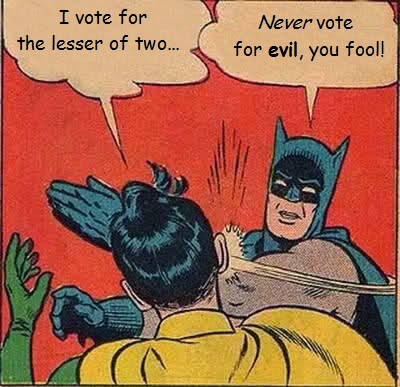
     In regards to voting, Catholics are taught that there are some policies which we just cannot reconcile with the common good, and so we cannot in good conscience vote for a candidate who supports those policies.  The policy that probably comes to your mind first is abortion.  In general, the Democratic Party in the U.S. is supportive of legalized abortion.  The Republican Party, in general, opposes laws which permit abortion.  No matter what other policies these two parties support, abortion just cannot be ignored when it comes time to cast your ballot.  It seems that, as a Catholic who regards all fetuses as human individuals, the decision is a no-brainer:  The common good is drastically opposed to the Democratic Party simply by that one token.  Yet, there is a grave problem in concluding that, therefore, one must vote Republican.  This strikes me as utterly narrow-minded and reminds me of the Jedi Council rallying the clone army under Chancellor Palpatine.*  It’s a trap.

     There is a fallacy named the “false dichotomy” whose definition helps us to understand the conundrum of which I speak.  A false dichotomy is a presentation of two points of view as if they were the only options, whereas others are available.  For example, “If you’re not a conservative, you’re a liberal” is a false dichotomy.  This only begins to express the whole problem of choosing a Republican over a Democrat. 

Who would you vote for?
Sure Lex Luthor is a bad guy, but he's great compared to Galactus!

     By now, you might be thinking “he’s alluding to third party candidates, but he might as well just not vote.”  It is sad but true, that to vote for somebody who is neither a Republican nor a Democrat is probably to throw one’s ballot into a three percent margin.  It seems that third party voters might as well stay home on Election Day.  My point here, though, is not a pragmatic one.  It is a moral one.  Catholics are not Utilitarians by principle; the consequences of an action do not make it good.  In fact, the principle by which most conscientious voters operate is to “choose the lesser of two evils,” in which case many consequences of the action would still be bad, just not as bad as the alternative.  Cut your losses, so to speak.

     But less evil is still evil.  Also, voting for a third party who would very likely not succeed is not equivalent to staying home and refusing to vote.  That is, action is still action, regardless of your success.  Is it better to try for the best possible option and fail or to compromise and succeed in securing evil?  If you still do not see how Republicans could be so bad, compared to everything Democrats stand for, have you ever considered the accusations against Republicans made by Democrats?  Have you ever considered that they might be true, regardless of the source’s own problems?  You might be thinking, “Sure, the GOP has its problems, but they’re not nearly as messed up as the Liberals’.”  This may be true, but it leads me to my main point.


     Here, I will define a fallacy which is based on the false dichotomy.  It is called “Satan’s Razor” and it is the mechanism by which a false dichotomy is created between two evils so that one is made to look good in contrast to the other.  Consider, for example, Communist Russia vs. Nazi Germany, using condoms vs. spreading HIV, or Godzilla vs. King Kong.  It is an insidious and clever lie to say that, because one stance is so evil, you are morally obliged to support its opposite.  The “razor” trick is ubiquitous, driving arguments from education (either feed the system or go stupid) to environmentalism (either abuse nature or don’t touch it).  As soon as you decide to support one side against the other, you have fallen into the trap.


     The morally conscious person is thoughtful with his principles and careful in his decisions.  Evil is nothing more than a defect; a flaw in something otherwise good.  The world is not a duality, a struggle between good and evil.  It is altogether good yet defective.  Instead of trying to fix one defect by increasing another, step back and think about what is really good and choose that.  If your efforts at a solution fail, at least you know that you did not contribute to the problem.