Showing posts with label morality. Show all posts

Thursday, January 19, 2017

Moral Necessity

     When one takes what is generally considered to be a "moral obligation," such as the golden rule or the Decalogue, and compares such an imperative to its practical application, he will soon find out that, in order to call it a law, he must admit that it is more like a civil law than a scientific law; i.e., the "obligation" is suggested but is not evident.  The word implies being drawn from some binding principle (cf. Latin, ligare), but there is nothing directly binding about these moral imperatives.  God Himself says, "Thou shalt not steal," but people steal all the time, and without divine intervention.  The "obligation" of such imperatives are more commonly understood in the sense that there are consequences for those who would disobey them.  In this sense, the imperative is conditional, and is properly understood as implying an "if" clause: "Thou shalt not steal - if thou wilt be spared," "Do unto others as ye would have them do unto you - if ye wish to inherit the Kingdom," etc.  This is probably the same way most people understand the moral import of civil law, e.g. "pay your taxes - if you wish to avoid punishment," which suggests that the "binding" quality of an obligation is found merely in the connection between an action and its imposed consequences.

     There are still real obligations, however, which are so immediately binding as to be called "moral necessities."  The Golden Rule nor any of the Ten Commandments are moral necessities, properly speaking.  This is simply because of what necessity is:  A necessity is that which cannot be impossible or, in other words, a necessity is something which has no alternative.  Take the 7th Commandment again: "Thou shalt not steal."  If it were a necessity, then nobody would be able to steal and, in which case, it would be superfluous to demand that men keep to their own property.  It could be argued that the very fact of the Commandments being commanded proves that they are not moral necessities, but rather practical rules which are based on necessities.  It may be that moral necessities are so little known precisely because they are necessary and not given to alteration or change of form based on their practical import.

     So, we are led to ask the question, "what then, are the moral necessities?"  Moral necessities can be found in what is called the "Natural Law."  In this case, "law" is more akin to the laws of physics than the civil law.  The necessities found in the Natural Law cannot be escaped precisely because they are necessary.  One example of a moral necessity, and part of said law, is that all men must will only what they desire.  This is about as practical as saying "all men must throw with their hands" but is nevertheless important in understanding the rules of morality, just as the necessity of throwing with one's hands is important in drafting the rules of baseball.  Nobody can choose to do something he does not desire to do (if only at least for the sake of something else) because if he chooses to do something he does not desire, he is not choosing it at all, but is rather compelled by some outside force.  (Here, perhaps, one can see what St. Thomas Aquinas meant when he posited that, if God were to “force” his will on a man, the man would still freely choose it because God would be working through the man’s will. God does not impose on a man as a master commanding a slave; rather, He works through men as the architect of his nature:  It is a poor architect who struggles against his own design. [S.T., P1, Q83, A1])

     At this point, it is now possible to show how the so-called moral imperatives are linked to moral necessities.  God, Who commanded certain acts and forbade others, establishes the Natural Law in the act of creating (and creation is not final but is ever dependent on its Creator), so His commandments are inherently linked to man’s nature, man’s ultimate purpose or end, and man’s happiness both now and in eternity.  Consider that it is a moral necessity to desire life and happiness.  Revisiting the 7th commandment once more, we are told “thou shalt not steal” because man necessarily needs material goods in order to live, it is necessary for him to live in society with other men in order to be happy, and it is impossible for a man to maintain a healthy society without mutually respect for the material goods they need.  Of course it is not impossible for a man to steal, but it is impossible to be both a thief and a good neighbor.  So, though the imperative can be ignored, the necessity cannot, and by defying the former, the latter becomes unbearable.

     The fact that man must desire what is good (because it is impossible not to) while at the same time choose to do evil is mere evidence of the fact that he is broken.  Even if he knew all the consequences of his actions, both external and innate, he would still not necessarily have the integrity to choose what he knows is good.  Men are not completely free to choose what they want or know to be good. But this does not negate the fact that each man would choose the good if it were in his power to do so.  The more one looks at the human condition of sin, his self-struggle, his incapacity to act in accord with his very nature, the more one might doubt whether there is moral necessity at all, for who can claim to act always with the clear aim of true and integral happiness, let alone claim that he has attained it?  Many people would not even admit to having even a desire for happiness.  But moral necessity, particularly that man must desire and choose the good, is rooted in a metaphysical necessity; namely, that all things are intrinsically good.  This deeper truth involves a commitment bordering on faith, the affirmation of existence, echoing the very words of its Creator, Who is nothing less than Goodness itself, “And God saw all the things that he had made, and they were very good.” (Gen 1:31)


Saturday, April 25, 2015

Satan's Razor


*In case you've never seen all of
Star Wars, read about Palpatine here.
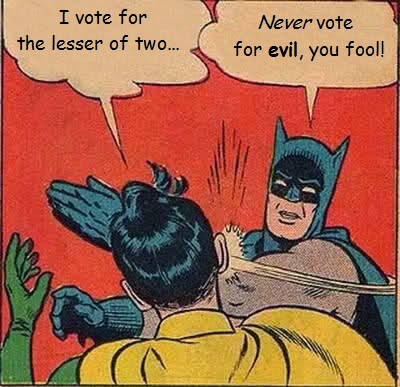
     In regards to voting, Catholics are taught that there are some policies which we just cannot reconcile with the common good, and so we cannot in good conscience vote for a candidate who supports those policies.  The policy that probably comes to your mind first is abortion.  In general, the Democratic Party in the U.S. is supportive of legalized abortion.  The Republican Party, in general, opposes laws which permit abortion.  No matter what other policies these two parties support, abortion just cannot be ignored when it comes time to cast your ballot.  It seems that, as a Catholic who regards all fetuses as human individuals, the decision is a no-brainer:  The common good is drastically opposed to the Democratic Party simply by that one token.  Yet, there is a grave problem in concluding that, therefore, one must vote Republican.  This strikes me as utterly narrow-minded and reminds me of the Jedi Council rallying the clone army under Chancellor Palpatine.*  It’s a trap.

     There is a fallacy named the “false dichotomy” whose definition helps us to understand the conundrum of which I speak.  A false dichotomy is a presentation of two points of view as if they were the only options, whereas others are available.  For example, “If you’re not a conservative, you’re a liberal” is a false dichotomy.  This only begins to express the whole problem of choosing a Republican over a Democrat. 

Who would you vote for?
Sure Lex Luthor is a bad guy, but he's great compared to Galactus!

     By now, you might be thinking “he’s alluding to third party candidates, but he might as well just not vote.”  It is sad but true, that to vote for somebody who is neither a Republican nor a Democrat is probably to throw one’s ballot into a three percent margin.  It seems that third party voters might as well stay home on Election Day.  My point here, though, is not a pragmatic one.  It is a moral one.  Catholics are not Utilitarians by principle; the consequences of an action do not make it good.  In fact, the principle by which most conscientious voters operate is to “choose the lesser of two evils,” in which case many consequences of the action would still be bad, just not as bad as the alternative.  Cut your losses, so to speak.

     But less evil is still evil.  Also, voting for a third party who would very likely not succeed is not equivalent to staying home and refusing to vote.  That is, action is still action, regardless of your success.  Is it better to try for the best possible option and fail or to compromise and succeed in securing evil?  If you still do not see how Republicans could be so bad, compared to everything Democrats stand for, have you ever considered the accusations against Republicans made by Democrats?  Have you ever considered that they might be true, regardless of the source’s own problems?  You might be thinking, “Sure, the GOP has its problems, but they’re not nearly as messed up as the Liberals’.”  This may be true, but it leads me to my main point.


     Here, I will define a fallacy which is based on the false dichotomy.  It is called “Satan’s Razor” and it is the mechanism by which a false dichotomy is created between two evils so that one is made to look good in contrast to the other.  Consider, for example, Communist Russia vs. Nazi Germany, using condoms vs. spreading HIV, or Godzilla vs. King Kong.  It is an insidious and clever lie to say that, because one stance is so evil, you are morally obliged to support its opposite.  The “razor” trick is ubiquitous, driving arguments from education (either feed the system or go stupid) to environmentalism (either abuse nature or don’t touch it).  As soon as you decide to support one side against the other, you have fallen into the trap.


     The morally conscious person is thoughtful with his principles and careful in his decisions.  Evil is nothing more than a defect; a flaw in something otherwise good.  The world is not a duality, a struggle between good and evil.  It is altogether good yet defective.  Instead of trying to fix one defect by increasing another, step back and think about what is really good and choose that.  If your efforts at a solution fail, at least you know that you did not contribute to the problem.

Friday, April 4, 2014

Rebuilding the Pantheon

     It is now quite obvious that a new age of paganism has dawned upon us.  No longer does Christian culture justly reign in the hearts and minds of the world.  This has been so, I think, for at least a century, but now it is easy enough to look around at the present state of things and deduce that the old pantheon has once again been enthroned on the principles of a false morality.

     Though many of the current generation might not conscientiously subscribe to any definite morality (I doubt if the average college student is even prepared to discuss what morality means), they live by a morality nonetheless.  We do not live in an amoral society.  Wherever there is approbation or affirmation, there is at least a sense of right and wrong and where there is a sense of right and wrong, there is a principle by which to judge something accordingly.

     Any and every different morality, complete or not, has an end; a perceived good to which that morality aspires.  For example, if one deems it right to care for personal hygiene, the good to which that norm aspires is the health of the individual.  Simple enough.  Christian morality has God as its end because God is goodness itself and all good things are good insofar as they come from God.  Furthermore, one can hope for happiness in apprehending good things because they ultimately lead one to happiness in God.  Hygiene, then, is a reasonable enough norm as someone who is clean and therefore healthy is more likely to be happier than someone who is not.

     But I am not writing to discuss hygiene.  What has become obvious to the Christian standing apart from modern culture is that God is no longer recognized as the end of morality.  He is no longer recognized at all.  And with the Source-and-Summit of goodness removed, the whole structure is dismantled.  We now see a scattered, fragmented collection of principles which have only sub-perfect goods as their ends, each set up as something worthy of worship in itself.

     I wish it were that society had only fallen under the demons of pagan Rome, where greedy traders and "honest workers" alike consecrate their lives to Vulcan and Mercury, where Venus bestows her blessing on the unbridled sexual escapades of youth, and where libations are offered to Bacchus in return for the destructive pleasure of drunken revelry.  Gaia has reformed her demands and now asks that you drive a Prius, eat only free-range eggs, and separate your recyclables.  Minerva, while still cherishing a few remaining rationalists, scolds those who are perhaps too "narrow-minded" to concede to the pedantry of her priests.

     These gods have indeed been resurrected, but a far more malicious and (thankfully still) controversial presence in our society is the resurgence of the older and much more sinister cults of Ba'al, to whom one was not a man until he sacrificed his virginity to the temple prostitutes, and of Moloch, to whom women sacrifice their children in the hope of being spared the hardships of a capricious life.

     The principles aforementioned are not (as of yet) personified as they were in pagan Rome and ancient Babylon, but they hold their false place of honor nonetheless.  What turns a veritable good into a vicious god?  It is that these ends of today's morality are set up as the end; that there is nothing more to live up to.  The art of pagan worship is nothing more than the art of fooling oneself into believing that happiness will come when the gods are appeased, despite their quarrelling even among themselves.

     What is a Christian to do in a neo-pagan world?  The answer does not come easily, but it helps to know what it means to be Christian and who one's gods are.

Monday, February 24, 2014

Letting Personal Beliefs Determine Public Policy

Can anyone separate himself in an enterprise from his personal morality?  In every forum of human activity, there is a crucial but often subtle correspondence to morality, be it politics, work, celebration, education, the liturgy, etc.  In fact, everything one does is a reflection of his morality in some way.  Every human activity is therefore bound to be misunderstood and poorly undertaken if the moral framework on which it is built is misunderstood.

Morality, simply put, is belief put into action.  Everyone has desires for what he believes is good and so what he believes, be it by faith or reason, has implications for how he decides what is a preferable choice or course of action.  For example, if one believes that air conditioners are bad for one’s health and that person wants to preserve his health more than he wants to keep cool in the summer, that person will probably not buy and use an air conditioner, unless of course, some other thing leads him to believe that he should.  Though this may perhaps seem to be a trivial example, it is still morality.  What morality is not is an arbitrary set of rules.  Even commandments and moral absolutes can be shown to be reasonable and representative of a conviction on what is good and desirable.

It is easy to see how any of the above mentioned examples of human activity ties into morality in a very deep way.  From a Christian perspective, morality is much more deeply intertwined in every facet of human life; from waking up in the morning to burying the dead.  This is because, for Christians, morality is life itself.  If morality is the pursuit of good on behalf of our own desire, then morality is the pursuit of God.  The moral life springs from much deeper fonts than commandments and precepts.  It is more akin to a love affair, in which every soul experiences an unquenchable thirst for something beyond this world; for life itself.  This is God, and He is goodness itself.

The moral life is sometimes called a participation in goodness.  I am not speaking here of some ethereal neo-platonic concept of fragmented bodies tending back into union with the One (though it is worth looking into).  To participate in something is to act in unison with those who are part of it.  It does not help to understand morality by saying it is “acting in unison with others who are also acting for the good.”    This is obvious.  What is extraordinary in Christianity, in speaking of participation, is that God, who is goodness itself, acts.  He in fact acts only in goodness.  Thus, to say that one “participates in goodness” is to say that one “participates in God.”  That is, one acts in unison with Him.  St. Thomas Aquinas goes even further in saying that, because God is perfect, there is no potential good in Him that is not already realized.  God is therefore pure act (though let’s not get ahead of ourselves).

When one acts for the sake of goodness, we call this love.  This is why we say that God is love, because He is goodness in action.  To act for the sake of something is to love that thing.  This works in every analogous sense of the word:  I love ice cream – I will find some and eat it:  I love art – I will create it and preserve it:  I love my wife – I will protect and honor her.  Because God is the good, everything is good by virtue of Him.  He created it; he maintains it, and everything good leads ultimately to Him.  We thus see that every act of love, in whatever sense, is a real participation in the goodness of God.

To say that something ought to be such-and-such a way is to commit to a standard in which that thing is considered good.  We maintain this standard in our beliefs on what is good.  If one, for instance, believes that free-market economy is good because of so-and-so, then he would be likely to say that the economy ought to be a free-market.  If this same free-market proponent were a Christian, it would stand to reason that he would believe a free-market economy (in some small way at least) to be a reflection of the goodness of God and a means of leading oneself to Him.  A Christian cannot reasonably conceive of any sphere of human activity as being separable or unrelated to his morality, be it politics, education, joke-telling, fishing, drinking, love-making, eating, working, nose-picking, reading or writing, buying or selling, child-rearing, painting, pissing, or sleeping.  Everything he does ought to be done out of love of God.  To believe one thing and act contrary to that belief on account of some other belief amounts to a contradiction of beliefs:  Such a person is unreasonable and a liar to himself.  If a Christian cannot sincerely believe that he does something in order to participate in the goodness of God, he ought not to do that thing, no matter what that thing is.

Saturday, August 3, 2013

Choosing Faith

I read something written by (presumably) an atheist the other day.  It read, "You don't choose to have faith.  You either believe something or you don't." 

This strikes me as literally weak-minded; as if the mind is purely passive.

When we are presented with some information, our mind does things with that information.  We think about it. We weigh it against other information we have previously received.  We then choose to accept the information as true or, else, we reject it as false (though perhaps choosing to remember the information since it often implies something about whence we obtained it). 

For instance, suppose one knows almost nothing about cosmology, astronomy, or physics.  Suppose then that he is presented with a striking proposition; the earth is a sphere.  Because he walks on level ground and sees the sun rise and set beyond a straight horizon, this comes as a challenge to what he has already assumed about the world.  Perhaps he hadn't decided to believe that the earth is flat, but merely took for granted that it was flat because it had always seemed obvious to him.  Now that he is confronted with this alternative belief, however, he must make a choice.  There is, for him, no definitive proof that the earth is either flat or spherical.  He might hear arguments from those who believe it flat and from those who believe it spherical; both of which make sense to him, yet neither offering absolute certainty.  A sailor says to him, “I see the mast before the ship,” while an astrologist says to him, “the stars spin above us in a circle.”  He himself has charted neither sea nor stars, but only understands as much as he can reason from the explanations of others.  The man does not accept the new theory as fact upon first hearing it.  He scoffs at first.  Then he wonders.  Then he listens to the arguments.  He weighs it against what he has learned and tries to imagine a universe different from what he had first imagined.  He is no fool, but neither is he stubborn.  He wants to know the truth about the world.  But alas, there is no way to be sure.  He makes a choice and deems himself a member of the newly educated few who now possess the extraordinary “knowledge” that the earth is a sphere (and a lot of good that will do him, too). 

This is no easy choice, however.  A few days pass and he finds himself listening to his neighbor complain about the heretics who claim that the world is an orb which revolves about the sun.  “I am no heretic,” he thinks.  He discards the belief which he so willingly accepted just days earlier.  Given a few more days, he glances into a shop and sees a series of maps, all of which are divided into oval segments, as if peeled from an apple.  “If such maps did not work, no sailor would return from sea.  Of course the earth is a sphere,” he reformulates.  Such a pattern might take place in his mind indefinitely.  Most often, however, it is important to note that there might not be any additional information which sways his mind to a particular belief.  It is usually only an impression or influence which causes him to decide that one proposition is better to believe than another.  Most often, if he is thoughtful, the impression might come from his own meditation.

The fact that one is moved to believe a proposition true by virtue of his own meditation is most especially important when belief in the proposition would effectively influence his action in everyday life.  The shape of the world, interestingly enough, does not usually affect how one conducts himself.  If one were faced with the proposition, “there is gold in Yukon Territory,” however, he must do some nimble thinking before acting on that knowledge.  Who gives him this information bears weight on his belief, plus the content and nature of the story he hears from the teller.  If a ragged and poor man claims to have returned from a gold-infested Yukon Territory, one might not be ready to believe it.  A government-appointed surveyor posting an official notice in the newspaper is more likely to be believed, however.  So there is gold.  How much gold?  That one person found gold does not guarantee that everyone who ventures into the wilderness will find it.  One who finds gold does not necessarily return home with every ounce.  Thus goes the usual thought process until one comes to a decision.  In this case, the decision is not a simple “true or false” judgment, as was the case concerning the shape of the earth.  When one decides to believe not only that “there is gold in Yukon Territory” but also “I will find gold in Yukon Territory” and “I will bring home the gold that I find,” the decision is almost a moral one.  The truth implies a course of action.  In this case, though, there is no way to determine that the propositions are true unless action is taken.  One must make the provisional choice to believe before the belief is verified.  If one chooses to believe that he will come home with gold, he will leave his home town behind and travel into the wilderness.  If he believes that he will likely die of starvation, hypothermia, disease, or wild animals before ever finding gold, or that, if he does find gold, he will likely die on the way back or fall prey to robbers, he will not leave home and travel into the wilderness.

It is often stated that belief is based not on certainty but on probability.  In this case, however, there is no probability.  The man who hears the news, “there is gold in Yukon Territory,” never met a man who traveled there.  There are no statistics in the paper and his only impetus amounts to a mixture of greed, hope, courage, and imagination.

This is not meant to be a nuanced reworking of Pascal’s “wager”.  Rather, both the first and second instances are meant to show that information and outside influence alone are not enough to move one to belief; subconscious or otherwise.  Faith, or properly speaking, ‘religious belief’, is a choice which one makes consciously in response to the circumstances in which one finds himself.  We are all presented with a very limited amount of information, most of which is obtained second-hand, while first-hand experience remains easily doubted (on account of the influence of modern philosophy).  All of the information we receive is either inconsequential to the manner in which we live or it is speculative, presuming that a consequence will happen.  To deny that the mind has the power to decided one proposition true and another false is to deny the existence of morality altogether:  Our actions depend on our beliefs; yet our belief itself is an action.  Information does nothing by itself.  We decided what to do with it.

Sunday, January 6, 2013

The Wages of Sin

Judas Returning the Thirty Pieces of Silver (by Rembrandt)

Every good Christian knows the Ten Commandments (or at least knows of them). If the average Christian cannot number them one to ten, he at least knows the basic gist of what they say.  The Ten Commandments instruct us how to be good; i.e. what God wants us to do.  It seems that most people, even non-Christians or non-practicing Christians, already try to live their lives more or less along those rubrics once written in stone.  Why follow the rules?  To most people, that seems an easy question. If you follow the Ten, you go to heaven. If you disobey, you go to hell.  This is the axiomatic framework of morality for the typical bible-believing Christian, but for Catholics, this is just the beginning.  For Catholics at least, each commandment has sub-categories built into it.  For instance, “Thou shalt honor thy father and mother” does not apply to parental authority alone and “Thou shalt not kill” forbids killing as well as any unwarranted physical harm to others and oneself.  Catholics are also compelled to develop virtues which also have sub-categories.  In its simplest understanding, sin is disobedience to the Commandments whereas vice is a defect in virtue.

Virtue and vice are opposites by nature.  Natural virtue is the habitual tendency towards good, formed in the will through practice and informed by our intellect in accordance with right reason. Simply put, virtue is a good habit.  Vice is nothing more than the habitual tendency (away from virtue) toward the extremes of evil. Where virtue would bring one up to greater nobility, vice pulls one down to brutality.  Every virtue has its opposing vices on either side – Prudence between foolishness and indecision – Justice between disregard and flattery – Temperance between self-neglect and gluttony – Fortitude between cowardice and recklessness.  These are often referred to as “natural” virtues; more commonly called 'Cardinal Virtues'.  But what of sin?  How does this ubiquitous and seemingly compulsive obsession amongst serious believers fit into the framework of Christian morality?

There are several misconceptions of sin which plague Christianity like a disease.  These, dare I say, are primarily of a proto-Protestant origin and are derived simply as products of bad theology which has likewise been affected to error by bad philosophy.  One prevalent misconception is born out of a voluntarist understanding of God.  In voluntarism, God’s will is what matters; his will constitutes the moral law.  The voluntarist sees God as good because the good is what God deems it to be: We must obey him because he wills it, but it does not follow that obedience to his will makes us good.  His will is thus seen as distinct from his nature.  This is an idea closely related to nominalism, which denies the existence of universals and instead sees the world as an assortment of particulars.  It thus deconstructs the universal ‘goodness’ into a quality which is associated to things only in the human mind.  It makes no sense in nominalism to talk about “participation in being” or degrees of goodness.  Nominalism denies the reality of “Goodness” per se.  In this way of thinking, what human beings see as good has nothing to do with morality: We must do what we are told.  These notions are indeed extreme (albeit this is a mild interpretation), but their influence is extensive.
One might not espouse such philosophy outright, but like any disease, though unseen, it is recognized by its symptoms.  The worst symptom is the worship of a false god. Though not intentional, those who misunderstand the moral law misunderstand who God is.  Voluntarism puts an all-powerful arbiter in the clouds which any Scholastic would identify as a resurrected demiurge who forgot that Jesus Christ has long since died and risen.  The oneness of this god is compromised when we isolate his will and his perfection is defiled when we deny him the nature of goodness.  Though pure voluntarism is opposed to most facets of Catholic theology, its symptoms persist among Catholics.  If one does not understand the nature of God (goodness), one does not understand the nature of goodness (God). This is the heart of Christian morality.  This, I hope, is evident.
Another common symptom is neglect for the human person.  Pious Christians sometimes tend to adopt an unhealthy, repressive mindset for the sake of leading a moral life because of an inadequate understanding of the spiritual life.  To save our souls, we follow the Divine Law. Sin tears man asunder, but grace makes him whole.  To merit the grace won for us by Jesus Christ, we must first obey his will.  Some then conclude that the spiritual life is little more than a sort of merit system in which the value of our actions is weighed by a divine judge who decides between heavenly reward and eternal punishment.  The illusion of legality is exaggerated even more for Catholics; throwing into the equation the nuanced theology of baptism, the sacrament of penance, purgatory, indulgences, degrees of punishment in hell and levels in the beatific vision, Marian promises, and the distinction between venial and mortal sin.  The theology is sound (take Her word for it), but a strong legalistic approach to it all is damaging to the spiritual life.  Too simple an understanding of merit and salvation imparts a bland voluntarist flavor to an otherwise rich Catholic theology.  Then of what does morality consist, if not a system of merit and punishment?  What does morality have to do with saving souls?   
To understand salvation, we must understand the soul. The soul possesses three faculties; desire, intellect, and will.  Our desire initiates the will, informed by the intellect.  We cannot will something unless we first desire it and we cannot desire something unless we know it to some extent (e.g. no one will want a breadfruit if he did not first know of such a thing).  The impetus of ethics is that our desires conflict. We know not what is more worthy of our desire, so we try to weigh out the good in those things.  Original sin has damaged all of our faculties and is the reason why we do not recognize the Good outright; though Christians should have it easy when it comes to ethics in general.  We should know what the Good is, how to choose it, and most importantly why to choose it.  But for some, it does not seem so simple. If one is stuck in a legalistic mindset, he loses touch with the heart of the spiritual life.  He becomes haunted by his inordinate desire because he usually desires anything but what is prescribed for him.  He cannot understand God’s justice because, instead of finding God desirable, he obsesses over the rules and finds the proscriptions of God’s law ever beyond his personal abilities.  Most regretfully, his sincere attempts at continual obedience to God’s law result in a kind of spiritual schizophrenia:  He constantly tries to oppose his own will even though his desires are neglected and his intellect ill-formed.
This mindset impedes our relationship with God.  Such a soul is still torn apart by the effects of sin:  He is constantly at odds with himself.  If he does not mature in his spiritual life, he will persist recklessly in disappointment or perhaps even give up on morality all together.  If we are stuck in a legalistic mindset, we are nothing more than criminals and God is our Father insofar as we are obliged to obey him.  We are put at enmity with God because it is our will versus his will:  Moral law serves only as man’s conviction with God as our accuser.

In order to understand morality, we must understand who God is.  St. Thomas Aquinas worthily identified God as none other than ipsum esse subsistens; i.e. the very act-of-being.  God is existing.  Therefore, to live virtuously is to have a greater share in existence.  God is goodness:  To act according to the Natural and Divine Law is to act as Goodness Itself intends.  Thus the better we are, the closer to God we become.  God is truth, so morality is apprehensible by reason. Goodness makes sense because goodness is truth.  In reality, as Thomas pointed out, goodness, truth, and being are all One. 
Morality starts with us and ends with God.  If Aristotle was right in positing that the end of ethics is happiness, then he was but a step away from Christianity.  What is heaven but the promise of eternal happiness? From whence does this happiness come but God alone?  It is crucial to understand that the end and aim of all our actions ought to be God Himself.  This is the sum of Christian morality.  As stated above, we cannot will something unless we first desire it.  This is a great consolation to us when we realize that nothing is more worthy of desire than God himself.  In this we should also note that our desire plays a crucial role in the spiritual life and so it is a sad mistake to try and crush it.  We want to be happy:  This is the beginning of morality!  There is more consolation still in that God wants us to be happy.  How can we can say this with certainty?  Because God wants us to obey Him. 
So now we are back to the matter of obedience. Let us, right here, sweat out the illness that is voluntarism.  God is all-powerful but in His goodness He respects our free will.  He does not force his will upon us.  If our wills were so corrupt that we were unable to choose the good at all then there would be no reason for morality at all, for what good is a law which no one can obey?  If the only way to obey is for God to will our obedience then we are justified regardless of our sad attempts.  The moral law and the “oughts” it instills in us is not the legal system of action and consequence which many unfortunately believe.  There is a moral law, there are “oughts”, and there are consequences, but God is not an arbiter who decides what consequences ought to follow our actions.  God does not chastise us in the way that a man chastises his children.  This is because of the nature of God and the nature of man.  God is the author of human nature.  Being perfect and good, God created man good.  Goodness is thus inherent in human nature, though it is greatly diminished because of sin.  To obey the moral law, therefore, is to reform ourselves back to the state of perfection in which God created us (and ultimately to unite us to Him).  Vice introduces sin and forms sinful habits which increasingly disorder us and rob us of happiness.  We were not created for unhappiness and death, but in sin our will separates us from God, who is life and true happiness.  God does not choose the means to punish us for offending him: Sin is the means by which we punish ourselves.  By sinning we lose control:  We obscure our intellect so that we do not recognize what is truly worthy of our desire and our desires run amok; unchecked by our weakened wills.
Here we come to see the proper meaning of “ought” in this context.  “Ought” is understood in respect to our desire; i.e. every ‘ought’ implies an ‘if’.  When it is said, “you ought to love God,” what is implied is “you ought to love God if you wish to be holy.” When we understand the nature of our relationship with God and our desire for happiness, the “oughts” fall into place.  If we wish to be happy, we ought not to sin.
So what exactly is sin? If God is Being, then sin is nothing.  It is emptiness and the lack of God in our souls.  If God is Goodness, it is the evil of human action.  It is the privatio boni – the privation of good (as St. Augustine called it) – in our souls. If God is Truth, sin is a lie. It is the desire for what is undesirable.  Sin is the corruption of our relationship with God; opposition to Love, to Truth, and to Goodness.
We come, at last, to the “last things”, i.e. death, judgment, heaven and hell.  God, who is Love and Goodness, does not want us to go to Hell.  However, with merciful and benevolent respect to our free will, he allows us to act as we may. If our actions corrupt our relationship with God such that we become blind to Truth, strangers to the Good, and hostile to Love, we are obviously unable to embrace God.  God nevertheless embraces us.  The soul in the state of grace, perfected in virtue and free of sin, is receptive to Truth and (quite literally) in love with Love.  It is no stretch of the imagination that, after death, such a soul experiences the infinite fulfillment of desire; happiness in Goodness Himself.  For the vicious soul rent apart by sin, the presence of God is something utterly intolerable.  In earthly life he grew in hatred for God and disgust at the moral law, immersed himself in lies, and haplessly chased death: Confronted with Goodness, with Truth, with Existence, the extent of his wretchedness becomes apparent and his suffering is complete.  Death merely finalizes what is developed in earthly life.  Hell is created by those who put enmity between themselves and God through sin.  Heaven begins to grow in the soul as soon as one begins to pursue God through virtue.