Showing posts with label Liberal. Show all posts

Saturday, March 5, 2016

A Brief History of the Family Decline

Early 1700s
The man works at home, either on his farm or in his shop, which is near or adjacent to his home.  He needs his wife and children to work around the house. Daily work can be anything from pulling weeds and feeding chickens to mending socks and spinning wool.

Late 1700s to Early 1800s
The Industrial Revolution is underway.  Men are encouraged (often forced) to leave home to work in factories, mines, or other specialized jobs so that he can earn a wage.  Because wages are so low, wives and children are often pressed into work to help earn needed income.

Late 1800s to Early 1900s
Public schools are instituted.  Children are sent off to school for most of the day.  By 1917, education is compulsory in every state for all persons between the ages of 6 and 17.

Mid 1900s
"Second Wave" Feminism fights for labor and "reproductive rights" for women.  The image of the career woman becomes a social norm.  The woman who typically tended the home by herself was encouraged to have less children and to enter the workforce.

Late 1900s to Today
Rising divorce rates, single parenting, gender confusion, LGBT activism, a struggling economy, and rampant depression all mark an age when the family is a faint and arguable notion.  Conservatives claim that LGBT activism hurts families, but the truth is that the family has been steadily declining over the past two centuries because of institutions and laws currently supported by both "Conservatives" and "Liberals."

Some Food for Thought
Those who wish to save "traditional family values" should focus on the general trend which has been progressing for centuries (such as the empty homes created by things we are now required to have) rather than its shallow symptoms (such as "gender identity" crises).  I suggest we take a step back, look at how we got to where we are, and re-think our current social climate rather than taking it for granted:

  • Would family or gender roles be as ambiguous as they are today if the whole family lived, worked, and learned at home?
  • Is there any way we could have raised the "standard of living" without removing the husband from his house?
  • Is there any way we could have improved education without institutionalizing and homogenizing it?
  • Is there any way we could have assured justice and equity for women without pretending that they are the same as men?
  • In what context is it useful to refer to any particular family as a family if its members perform no meaningful activity together?
  • Is there any way we could return the family to the home (e.g. is it possible to make work and education family business, rather than corporate or state business)?  Would anyone want that?

Wednesday, September 9, 2015

Andy and The Emptiness of Social Justice, Part II: Soft Slavery

     After all his thought, Andy has come upon a stunning realization about ownership and the widespread lack thereof.  There are some basic points which sum up Andy's incapacity to make the difference he thought he could.

1. He is completely dependent on others for everything.

The clear and simple truth about needs is this:  No matter how much money one has, he still gets what he needs from someone else.  Money does not equate to wealth.  Production equates to wealth:  If one has the ability to produce what he needs, it does not matter whether he has money or not, and so long as he can produce what people need, people will give him money for it.  If Andy gives money to the poor and needy, their problems might subside for a little while, but because they are unable to produce anything at all, they will continue to be needy, if not for food, shelter, and clothing then for money to buy food, shelter, and clothing.  What follows from this is that the vast majority of people are needy.  They need someone to give them what they need and they have nothing to trade for it except labor.  A few lucky people might be able to make money without working (just like Andy could by investing his new fortune) but he knows very well that not everyone can do this.  Most people have to work because things need to be produced (and because workers need money), but most people do not produce anything.  "How can this be?" he wonders.  Why is it that most people work but those same people are dependent on others for everything they have, especially the things they need, like food, shelter, and clothing?

2. Others will give him what he needs only out of kindness or obligation.

Everything Andy owns has either come to him as a gift or as an exchange for something else.  He knows that people will be needy so long as they depend on the kindness of others (which usually does not go far).  If he or anyone else is to have any degree of economic security, they cannot simply be charity recipients. Yet the only other way he can get anything at all is by convincing someone that he owes him.  Andy could do this by giving someone money, which is agreed to be worth so much of whatever he wants in return.  Andy has a lot of money currently, but the money he has will be used on consumable things, which means that he will eventually run out of money.  And how does he get more money?  He gets more money by working... for someone else.  The fact about trading is that not only does he get everything he needs from someone else, he even gets his money from someone else.  Before he can trade money for things, he must trade work for money.  This means that before Andy can even think about receiving the things that he wants, he has to find someone to work for.

3. The only thing he can trade is labor.

It is quite obvious that the only thing of value which Andy has to trade is his labor, though his labor has absolutely no value on its own.  In order for his work to be valuable, someone else must decide how he should work, when he should work, and where he should work.  Andy does not really own his own labor:  Before he is hired anywhere, it is understood that whatever his work accomplishes does not belong to him at all.  He has absolutely no say in what to do with his own labor, let alone what to do with the results of his labor.  In exchange for labor, Andy will be paid in money, but he will probably have no say whatsoever in how much money his labor is worth.  If, for example, Andy gets a job making baseball bats, he will not decide what time of day to make bats; he will not decide what shape to make each bat or what color to paint it; he will not decide how much time to spend on each bat; he will not own any of the bats he makes; he will not decide how much each bat is worth; and he will not be paid based on how many bats he makes or how well he makes them, but on how much his manager thinks he should be paid.

4. He does not really own anything.

The fact that Andy does not even own his own labor makes his fifty million dollars seem like an odd puzzle.  Does he not own fifty million dollars?  Well, if by "own" we really mean "can use it however he wants," then no.  If by "own" we mean "nobody can take it away," then no.  If by "own" we mean "can hold it in his hands for a while" then yes, he owns fifty million dollars.  This is how people "own" things.  If Andy buys a beach house and a Lamborghini on credit, then the banks really own those things until he pays them off.  Andy has enough money to buy those things with cash, but even if they are bought and paid for in full, he must still pay to "own" them.  He will still have to pay taxes in proportion to the value of his property.  If he does not pay these taxes, those things will be taken away from him.  Also, depending on the state or town his lives in, there will be many restrictions on how he uses his property, from zoning laws which restrict what the property can be used for to local ordinances which could prohibit anything from cutting down trees to raising livestock.  Thus, not only must he pay to keep his property, he can only use his property in ways others allow him to.

5. It is impossible for him to own anything.

Andy would like to give the poor and needy the ability to be producers, to make what they need and keep it, to acquire basic necessities and to avoid having these things squandered or taken from them.  The hard but simple truth, however, is that not even Andy can have this.  There is no way, not even with fifty million dollars, that he can permanently set himself up with food, shelter, clothing, or any other needs or wants; not because those things get used up, but because he has no way of securing those things for himself.  If he bought a plot of land, built a house, planted a farm, and sewed himself new pants every year, he would still lack two major elements needed for a decent life; security and community.

He would lack security because his land and his house is ultimately State domain:  If he does not continue to pay money to the State for the use of his own "property," the State will reclaim his property. If he uses his property in a way not approved by the State, the state will punish him accordingly.  He would neither be assured to keep his property nor would he have free reign over it.  In short, the only thing "property" is sure to mean is that somewhere there is a piece of paper that associates his name with it.

He would lack community because he could not effectively feed or house or clothe himself without the help of others.  It would be easy to get help if others were trying to do the same thing as him (that is, to really own something) but food and housing and clothing are generally only available from people who want money.  It might be possible for Andy to grow everything he needs to eat and to maintain a house by himself, but that would leave him at a severe disadvantage in the quality of his life, which would easily be remedied if he focused on producing perhaps one or two things he needs instead of everything:  After all, being completely self-sufficient would likely be a hard and lonely life.  Even a self-sufficient man needs community.

If he became a producer of something he could enter the market as a real owner and be able to trade something valuable in place of servile labor.  But community implies a spirit of solidarity in which each member aims to protect the interests of every other member; not out of kindness or obligation, but out of mutual respect.  This community is generally lacking among the few people who actually own things.  In fact, the market is not a community at all, but an arena, a place of fierce competition where the success of one producer is precariously balanced with the potential failure of another.  Andy might be able to become a formidable competitor with a fifty million dollar business, but his goal is not to compete and to win, but to enter into a community and reduce need out of mere appreciation for men.  But because community is almost non-existent, the more people Andy makes producers the less they will be able to compete.

So Andy seems to be left with two options.  Either he tries to make himself an owner, albeit tentatively, and help the market deprive people of property, or subject himself to a soft slavery, in which he is "free" to offer his labor for an arbitrary price so that he can buy what is put in front of him and use things as he is allowed to.

Saturday, April 25, 2015

Satan's Razor


*In case you've never seen all of
Star Wars, read about Palpatine here.
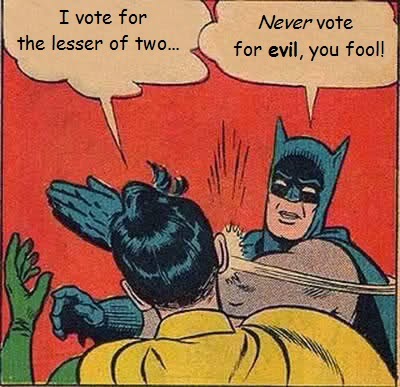
     In regards to voting, Catholics are taught that there are some policies which we just cannot reconcile with the common good, and so we cannot in good conscience vote for a candidate who supports those policies.  The policy that probably comes to your mind first is abortion.  In general, the Democratic Party in the U.S. is supportive of legalized abortion.  The Republican Party, in general, opposes laws which permit abortion.  No matter what other policies these two parties support, abortion just cannot be ignored when it comes time to cast your ballot.  It seems that, as a Catholic who regards all fetuses as human individuals, the decision is a no-brainer:  The common good is drastically opposed to the Democratic Party simply by that one token.  Yet, there is a grave problem in concluding that, therefore, one must vote Republican.  This strikes me as utterly narrow-minded and reminds me of the Jedi Council rallying the clone army under Chancellor Palpatine.*  It’s a trap.

     There is a fallacy named the “false dichotomy” whose definition helps us to understand the conundrum of which I speak.  A false dichotomy is a presentation of two points of view as if they were the only options, whereas others are available.  For example, “If you’re not a conservative, you’re a liberal” is a false dichotomy.  This only begins to express the whole problem of choosing a Republican over a Democrat. 

Who would you vote for?
Sure Lex Luthor is a bad guy, but he's great compared to Galactus!

     By now, you might be thinking “he’s alluding to third party candidates, but he might as well just not vote.”  It is sad but true, that to vote for somebody who is neither a Republican nor a Democrat is probably to throw one’s ballot into a three percent margin.  It seems that third party voters might as well stay home on Election Day.  My point here, though, is not a pragmatic one.  It is a moral one.  Catholics are not Utilitarians by principle; the consequences of an action do not make it good.  In fact, the principle by which most conscientious voters operate is to “choose the lesser of two evils,” in which case many consequences of the action would still be bad, just not as bad as the alternative.  Cut your losses, so to speak.

     But less evil is still evil.  Also, voting for a third party who would very likely not succeed is not equivalent to staying home and refusing to vote.  That is, action is still action, regardless of your success.  Is it better to try for the best possible option and fail or to compromise and succeed in securing evil?  If you still do not see how Republicans could be so bad, compared to everything Democrats stand for, have you ever considered the accusations against Republicans made by Democrats?  Have you ever considered that they might be true, regardless of the source’s own problems?  You might be thinking, “Sure, the GOP has its problems, but they’re not nearly as messed up as the Liberals’.”  This may be true, but it leads me to my main point.


     Here, I will define a fallacy which is based on the false dichotomy.  It is called “Satan’s Razor” and it is the mechanism by which a false dichotomy is created between two evils so that one is made to look good in contrast to the other.  Consider, for example, Communist Russia vs. Nazi Germany, using condoms vs. spreading HIV, or Godzilla vs. King Kong.  It is an insidious and clever lie to say that, because one stance is so evil, you are morally obliged to support its opposite.  The “razor” trick is ubiquitous, driving arguments from education (either feed the system or go stupid) to environmentalism (either abuse nature or don’t touch it).  As soon as you decide to support one side against the other, you have fallen into the trap.


     The morally conscious person is thoughtful with his principles and careful in his decisions.  Evil is nothing more than a defect; a flaw in something otherwise good.  The world is not a duality, a struggle between good and evil.  It is altogether good yet defective.  Instead of trying to fix one defect by increasing another, step back and think about what is really good and choose that.  If your efforts at a solution fail, at least you know that you did not contribute to the problem.

Thursday, May 15, 2014

Americanism and Democracy


       “Do not conform yourselves to this age but be transformed by the renewal of your mind, that you may discern what is the will of God, what is good and pleasing and perfect.”  Rom 12:2

In 1899, Pope Leo XIII addressed the encyclical, Testem Benevolentiae, to Cardinal Gibbons of Baltimore (the Premier See of the United States) concerning a heresy he referred to as “Americanism.”  In the encyclical, Leo described Americanism as describing collectively a set of opinions to which he believed the American cultural and political atmosphere to be especially susceptible:

“The underlying principle of these new opinions is that, in order to more easily attract those who differ from her, the Church should shape her teachings more in accord with the spirit of the age and relax some of her ancient severity and make some concessions to new opinions.”

That is, if the Church would “get with the times,” there would be greater harmony between the world and disgruntled believers alike.  Cardinal Gibbons was quick to reply, stating in defense of the Church in America that the opinions against which Leo had spoken were virtually non-existent among American Catholics.  Gibbons might have been honest at the time, but Leo was no fool.  About a century later, it is obvious that Americanism is very much alive.
            The reason Americans are especially susceptible to such opinions is that, although they are in principle a democratic people, there is a widespread confusion as to what democracy means.  When one asks any Christian what his beliefs are, he is likely to get an answer like “Conservative Baptist” or “Liberal Catholic, but…”  It seems that Christians let their democratic-political way of thinking shape their religious views.  In addition to this muddling of principles, however, there is a ubiquitous conviction of belief in the separation of Church and State.
            Many argue that Leo XIII sought to abolish this belief, but those who make this assertion misunderstand it.  The Founding Fathers designed the American system of government in response to a system which they felt was too easily prone to tyranny.  A monarchy or aristocracy does not necessarily have a vested interest in the good of their subjects unless it threatens their own wellbeing.  The apparent solution to this problem was to create a government in which the good of a people was put into their own hands under their own governance.  This implied, however, that the people knew well enough what was for their own good.  Activists like Thomas Paine showed that the general population could indeed be well-enough equipped to handle their own affairs so long as the public was capable of participating in the political forum.  It was this capacity for the free exchange of ideas that was seen as the leaven of democracy, though American society at the time was unanimously Christian:  Many social goods that are the center of controversy today were no more than a natural and common disposition.  It is well-known that there was a prejudice against “Papists” which lasted into the nineteenth century mainly for the reason that Catholics were perceived as living under papal obedience and thus incapable of holding their own opinions in the public sphere.  This prejudice, of course, dwindled over time as it became evident that even Catholics could keep Church and State separate.
            The fact that this prejudice existed at all shows that Church and State bear a much closer relationship than is commonly thought, and our forefathers knew this.  Both the Church and the State concern man and his actions with one another.  Whatever one’s religious beliefs may be, they will manifest themselves in his actions, yet one’s actions are also the subject of laws and policies enacted by the State.  Ultimately, therefore, it seems that one need only to determine which actions concern religion and which concern public policy.  This is the general understanding of the separation:  What concerns public policy is one thing and what concerns religion is another.  This usually works well.  The State can mandate brake lights and window tax while the Church obliges Sunday worship and works of charity.  So what do we do when the State commands a priest to testify against his confessants or legalizes the murder of unborn children?
            When “separation” is understood only as drawing a line between the two, there inevitably arise ambiguities of authority which turn the distinction between Church and State into a fierce antagonism.  It should be surprising when it happens, especially in a democratic society, because each institution is concerned with the same thing; namely, the good of the individual and of society.  When each institution becomes the other’s rival, both the individual and society are torn apart, and this is ultimately disastrous for both: “A house divided against itself cannot stand.”  The separation of Church and State, then, is only a healthy separation if they strive for a mutually sustainable goal.  Only then will they not interfere with each other.
            American government is designed to prevent tyranny.  Christianity teaches that there is no greater tyranny than sin and moral depravity.  A cursory knowledge of history demonstrates that the most despotic of nations are also the most depraved.  There is nothing which is inherently at odds between sound moral doctrine and sound civil management, yet there is nevertheless a growing demand from “progressive” Christians to change what they believe to be “outdated” theology as well as federal law, as if what is good and natural changes with the times.  Why can we not just live in the 21st century?  Because Christians live according to a Truth that is eternal and a law which is in accord with that Truth.  A law devoid of Christian morals is ripe for tyranny, democratic or not. 
A true, healthy democracy is not the rule by a majority which decides what is good for their country, it is the rule by a majority which seeks the good of their country.  The greatest good will never be found without the guidance of Christianity.  Democracy is perhaps the safest system of government for its citizens, but an un-Christian majority is ignorant of the goodness of God and thus doomed to live in dysfunction, as Saint Thomas Aquinas observed in the first response of his Summa:

“It was necessary that man should be taught by a divine revelation; because the truth about God such as reason could discover, would only be known by a few, and that after a long time, and with the admixture of many errors.”

Monday, February 24, 2014

Letting Personal Beliefs Determine Public Policy

Can anyone separate himself in an enterprise from his personal morality?  In every forum of human activity, there is a crucial but often subtle correspondence to morality, be it politics, work, celebration, education, the liturgy, etc.  In fact, everything one does is a reflection of his morality in some way.  Every human activity is therefore bound to be misunderstood and poorly undertaken if the moral framework on which it is built is misunderstood.

Morality, simply put, is belief put into action.  Everyone has desires for what he believes is good and so what he believes, be it by faith or reason, has implications for how he decides what is a preferable choice or course of action.  For example, if one believes that air conditioners are bad for one’s health and that person wants to preserve his health more than he wants to keep cool in the summer, that person will probably not buy and use an air conditioner, unless of course, some other thing leads him to believe that he should.  Though this may perhaps seem to be a trivial example, it is still morality.  What morality is not is an arbitrary set of rules.  Even commandments and moral absolutes can be shown to be reasonable and representative of a conviction on what is good and desirable.

It is easy to see how any of the above mentioned examples of human activity ties into morality in a very deep way.  From a Christian perspective, morality is much more deeply intertwined in every facet of human life; from waking up in the morning to burying the dead.  This is because, for Christians, morality is life itself.  If morality is the pursuit of good on behalf of our own desire, then morality is the pursuit of God.  The moral life springs from much deeper fonts than commandments and precepts.  It is more akin to a love affair, in which every soul experiences an unquenchable thirst for something beyond this world; for life itself.  This is God, and He is goodness itself.

The moral life is sometimes called a participation in goodness.  I am not speaking here of some ethereal neo-platonic concept of fragmented bodies tending back into union with the One (though it is worth looking into).  To participate in something is to act in unison with those who are part of it.  It does not help to understand morality by saying it is “acting in unison with others who are also acting for the good.”    This is obvious.  What is extraordinary in Christianity, in speaking of participation, is that God, who is goodness itself, acts.  He in fact acts only in goodness.  Thus, to say that one “participates in goodness” is to say that one “participates in God.”  That is, one acts in unison with Him.  St. Thomas Aquinas goes even further in saying that, because God is perfect, there is no potential good in Him that is not already realized.  God is therefore pure act (though let’s not get ahead of ourselves).

When one acts for the sake of goodness, we call this love.  This is why we say that God is love, because He is goodness in action.  To act for the sake of something is to love that thing.  This works in every analogous sense of the word:  I love ice cream – I will find some and eat it:  I love art – I will create it and preserve it:  I love my wife – I will protect and honor her.  Because God is the good, everything is good by virtue of Him.  He created it; he maintains it, and everything good leads ultimately to Him.  We thus see that every act of love, in whatever sense, is a real participation in the goodness of God.

To say that something ought to be such-and-such a way is to commit to a standard in which that thing is considered good.  We maintain this standard in our beliefs on what is good.  If one, for instance, believes that free-market economy is good because of so-and-so, then he would be likely to say that the economy ought to be a free-market.  If this same free-market proponent were a Christian, it would stand to reason that he would believe a free-market economy (in some small way at least) to be a reflection of the goodness of God and a means of leading oneself to Him.  A Christian cannot reasonably conceive of any sphere of human activity as being separable or unrelated to his morality, be it politics, education, joke-telling, fishing, drinking, love-making, eating, working, nose-picking, reading or writing, buying or selling, child-rearing, painting, pissing, or sleeping.  Everything he does ought to be done out of love of God.  To believe one thing and act contrary to that belief on account of some other belief amounts to a contradiction of beliefs:  Such a person is unreasonable and a liar to himself.  If a Christian cannot sincerely believe that he does something in order to participate in the goodness of God, he ought not to do that thing, no matter what that thing is.

Wednesday, March 7, 2012

Hello, My Name is Ian and I Am Heterosexual (or) Don't Tell Me What to Teach My Kids

     Why would people not be allowed to love each other? This question is often the spearhead to any debate over the legalization of gay marriage, or “marriage equality” as it’s been dubbed. The notion of having a couple’s love recognized by the public eye, i.e. the government, and thus enjoying the benefits which go along with this recognition, has as its supporting foundation this simple idea: We are allowed to love each other. How could those who oppose a love so strong and fast, so undeniably true and vivid in the hearts of lovers, woman and man and other alike, be seen as anything other than monstrous? Indeed, as we learn from the most ancient of poets, the value and force of love and the tie it binds between those involved is nothing short of divine. Who are we to lay constraints on a love which is looked down upon simply because we are not used to it? We, who are not accustomed to the public cry for social acceptance of diverse nuclear families since the invention of in vitro fertilization and AI must learn to cope with, nay, to embrace the diverse character of the human eros. Right?

     Well, let us step back for a moment and see why the angry cry to “love and let love” has not been met with satisfaction. What the heck is love? Well, obviously love means sex, right? When a same-sex couple says that they love each other, that is, after all, what they ultimately mean. I have a few good friends (male like me) whom I can say I “love”, but I am certainly not engaging in sexual activity with them. So by “love”, in this context, it is inferred that sex is the definitive factor in the relationship. There, however, seems to be a problem with this. It appears that sex, in today’s (secular) society, has virtually no relation to the institution of marriage. So what is the issue, precisely? It appears that the issue is not at all precise! In fact, it is so imprecise that I fear I can only speak for myself and my own worldview, lest I get mixed up in the political thicket of liberal and conservative ideals. Again, I fear I cannot stress enough that I am not speaking on behalf of either political faction (I mean… party).

     So back we go to finding the issue. If love means sex but sex does not mean marriage, what is the issue? There is an issue, we cannot doubt, so there must be a problem with these definitions. Supposing love has little to do with sex (for it would be monstrous to divorce the two completely), what kind of love are we speaking of when we say that people who love each other should have the right to be married? Perhaps it is not only a love that thrives on reduced income tax liability, but one which bears to the married couple the right to raise children. Ah, children, the third part and full completion of love, follow only naturally from the culmination of personal intimacy. Well, usually...
But the fact that life does not naturally flow from the intimate union of a particular pair of lovers does not matter when they can have someone else’s child, right? After all, just as sex has little to do with marriage, neither does it have much to do with children these days. But this is at the core of the desire for marriage – to have the relationship recognized by society so that children may be raised under the stability of two parents. Observations suggest that I may have this wrong also, but I will leave that alone for now. To be honest, I find that the more I try to understand the underlying principles which support the case for “marriage equality”, the more confused I become. I will, therefore, stop trying to understand until someone kindly enlightens me.

     I feel, however, a great need to make clear the principles which underlie my own perspective as a Roman Catholic (vivat papa!). I have noticed a few jabs at my favorite old grey single man in a pointy hat whom I call the Holy Father. I have noticed that there seems to be a great deal of animosity toward him and the college of like-minded old grey single men in pointy hats whom I call Reverend Bishops. The feelings of hatred toward the faith I profess has been something the Church has had to deal with since we hid on the day of Jesus’ crucifixion. It simply does not faze us. What does faze us is when we send our children to school and they are taught things which directly contradict our faith. And so, finally, I come to my purpose here: Somebody please think of the children.

     So, what exactly does my Faith have to say about all these “diverse” people who want to get married? Where else could I go but the Bible, right? Well, for the sake of all those not in the choir, I shall refrain from going there. For the Catholic Church, marriage is sacred. It is to join a man and a woman together for two reasons, love and babies. These two things are so essential to marriage that you just cannot have one without the others. Not only does this fly in the face of “marriage equality”, but also contraception, abortion, fornication, and divorce. Marriage is neither some narrow-minded provincial tradition nor a cold-hearted dictum forced upon the sheepish masses of the Christian faithful by an oppressive regime of castrated old men. Simply put, our bodies are so sacred that we cheat ourselves if the contract is not for life. There is no sex without marriage, but, believe it or not, there is no marriage without sex. Now here we come to something really controversial: Because there are no children without sex, there ought to be no sex without children. This is not to derive an “ought” from an “is”, this is to make certain that no person is used as an object for pleasure’s sake. This is, furthermore, not to say that God punishes the pleasure of the marital act by giving the couple babies (unless of course you’re gay). It merely means that any act of love, if it is really love, involves creation.  This is not the case because my Faith teaches it, my Faith teaches it because this is the case.

     Notice how emotions have not been mentioned. Sure, emotions can be good, helpful, and entertaining but they can be pretty messed up, too. Not many people would argue that emotions which involve destructive tendencies are not to be held in check: No matter how angry I get, it is not okay to punch someone in the face. There is a law which forbids it and for good reason. Emotions cannot be the only factor in deciding to marry. This I say as a Catholic. As an American, we each have a right to believe what we want (however incorrect that belief may be) and so long as it does not infringe upon the rights of others. Yet, more often than not, beliefs clash: Catholics believe in a duty to teach their children the Faith while others believe in a duty to teach Catholic children other, contradictory things. It is our right to hold what we do; we can even talk about it and have grownup discussions. Just keep our kids out of it.