Wednesday, August 12, 2015

Andy and The Emptiness of Social Justice, Part I: What Fifty Million Dollars Can Teach You

Andy is a sociology major.  He wants to do good.  He cares about social justice and dreams of finding a solution for societal problems, such as drug addiction and homelessness.

For his birthday, one year, Andy receives a lottery ticket as a gift.  He is hesitant, but politely accepts and finds, to his bewilderment, that it is a winning ticket.

Well, what a surprise...
Andy is now the not-so-proud recipient of $50 million, compiled through crushed hopes and desperate irresponsibility.  His friends suggest buying a Lamborghini and a beach house and his family recommends investing in biotech, yet Andy knows that, in order to balance the scales of justice, he must find a way to use this stroke of fortune to help those in need.

Tempting...
He realizes, contrary to his friends’ fantasies, that spending a limited sum of money on luxuries will ultimately result in losing both his money and his luxuries.  Due to taxes, insurance, and the inevitable amount of upkeep a mansion and a sports car would require, it would take not only a gigantic but a continuous flow of income to maintain such a lifestyle. Money is fluid, his parents tell him.

His parents’ advice is to find a way for his money to make money:  That is, if he wants to keep his fortune, he must find a way to produce a fortune.  With so much money, they say, it should be easy enough to invest it in ways that will at least maintain his wealth for the future.  Andy is a thoughtful young man, and this advice strikes him as practical, but ultimately self-serving.  He decides to conjure up a plan to use the money in a way that will benefit mankind, beyond himself, yet in a way that will last like any wise investment.

He considers a few ideas that he has entertained, in the past as only daydreams, yet now very much within his reach: 

He imagines that, were he simply to give away his whole fortune to the poor and needy, it would flow away even more quickly than if it were to be poured into a garage full of Lamborghinis; not because the poor are principally irresponsible, but because money is gone once it is spent.  $50 million could feed an entire country for a year, maybe five years, then it would be gone, and both he and the poor would be back where they started.


Perhaps, he reasons, he could build schools and start scholarships and fund free education.  Perhaps, he reasons, he reasons too much, because the schools he would build would be to empower their students.  Knowledge indeed is power, and the investment he would put into it would likely remain stable, but what kind of power is it?  Education would improve lives by providing skills which would increase chances of employment but, without the opportunity for employment, skills are useless.  He himself is educated and were it not for the grim indifference of luck, he would still be working a part-time job for which he is quite over-qualified.  Education seemed like a noble cause at first, but Andy would like to do more than create candidates for unemployment.
 
Model Employees
If education empowers, but is useless without opportunity, he must create opportunity, he thinks.  But how does one do that?  The needy are in need of a living; the poor are poor not because there is want of charity, but because they cannot support themselves.  Andy is convinced that the answer must be to create jobs.  This is a very difficult problem and he is beginning to understand why nobody else has solved the issue of poverty yet.  To create employment effectively, he must become an employer, he decides.  To become an employer, he must secure a labor-based income for his employees; to do that involves business and production.  The more Andy tries to figure out how to help people, the more his thoughts become entwined in schemes very far from his initial ideas. 


Happy little workers, working happily...
He does not want to believe that creating a business is the surest way to help those in need.  Businesses create value, but they do not generate money.  When a business makes a profit, it is because it takes in more money than its products are worth:  What is an income to one is an expenditure to another.  To create a business would only add one more competitor to the market and might ultimately disadvantage as many people as it would help. 

This much is only speculation, Andy realizes, but he discovers that, when it comes to business in general, some things are certain.  One is that the most successful businesses merely supply what is in high demand and that actually producing those things are, in practice, secondary to making a profit from them.  He also realizes that demand is not often the same as need:  The things we need, like food and clothing, are actually quite common and cheap, whereas the things we demand (i.e. want and pay for) are usually more expensive and hence encourage much business to supply.  If business is the answer, then in order to benefit those who cannot produce what they need, he must supply what others demand, so that he can turn the needy unemployed into employed demanders.

To Andy, this seems to be counter-intuitive, and his suspicion is that it seems counter-intuitive because it is counter-productive.  Why would it not be possible simply to let people produce what they need?  Why could he not somehow turn the needy directly into producers?  Perhaps, he thinks, he should figure out what it is exactly that people need.  He does not think it fair to strive only for the survival of the needy; he wants to encourage a decent quality of life for them as well.  There is certainly a global spectrum of poverty, which ranges from starving expatriates to dispossessed addicts, and even fifty million dollars will not be able to help them all.  Andy begins to become depressed by the thought of a sound fortune with nothing to spend it on.  He decides that five of those dollars can go towards a beer and he makes his way to the local pub.

Later at the pub, Andy beholds a striking revelation as he leaves a fiver on the bar in exchange for his frosty beverage.  He had not even thought of the transaction before he made it, but his new net worth has put transactions in a new light for him; he himself has no way of getting anything, whatever the need or demand, without paying for it.  He could buy virtually whatever he wants, but he still has to buy it.  Why?

Socialism: "You work, we'll decide what you need."
Andy goes for a long walk to mull over this question.  Certainly money makes getting things very easy, so long as one has money, but this is a problem for those who do not have money:  The things that one needs are almost always made for the specific purpose of selling them.  So, if one has no money, he cannot get what he needs.  His last five-dollar purchase has made Andy realize that not even he, with all of his money, can change the way this works.  Necessities cost money, which one makes through employment.  He thinks of a type of employment in which employees are given necessities directly as compensation, but this seems very disagreeable to him, almost like slavery.  Money creates a convenient flexibility of purpose; the choice of what one buys is up to the one who buys it and employers do not have to decide for their employees what they should or should not have.  Of course, employers could not give their employees anything but money anyway, because whatever an employer supplies or produces is usually not a necessity, as Andy has already noticed.  So, he figures that standard employment works best as a money cycle:  Each business sells things to its customers and gives a share of the money to its employees. 


In this money cycle, though, each kind of poverty finds its own kind of problem.  He could fly into some famine-stricken third-world village and hand out hundred-dollar bills, but the money would be useless in a place where there is nothing to buy.  He could approach the homeless in any industrialized city and hand out hundred-dollar bills, but they would likely not spend that money wisely.  He could go to either place, address the people’s needs, and buy things for them, but there are already organizations which do precisely that.  It seems to become more clear to him, but Andy feels that tapping into a money cycle is quite a roundabout way of promoting social justice.  After all his thinking, he is convinced that people should be able to produce what they need, even if the world is too complicated to let that happen now.

When beach houses don't seem like a problem...

As far as what they need, he knows that rations and a tent do not lift a man out of poverty.  He now knows too, however, that three square meals and an apartment do not make a man rich, and neither does a Lamborghini and a beach house.  He knows which of these he would prefer to have, but fifty million dollars have convinced him that the value of money is not relative (as he used to think) but arbitrary.  Money only goes as far as those who want it; that is, it is only good for buying things, but what he buys and why he buys it is up to him and, then again, sometimes it is not.  He has no control over what his money means, just as the poor have no control over what their lack of money means.  If he wants to liberate the poor (and himself) he must liberate them from that which makes them poor; and it is not money.  It is the inability to produce what they need:  It is their absolute dependence on others to supply them with what they need for a price which others determine.


Thursday, May 14, 2015

Thoughts on Marriage

It is most likely that the ancient Athenian men, who made no qualms about enjoying sexual intimacy with their male companions, would have thought that the prospect of marriage between two men was not rude or immoral, but useless, impractical, and thus absurd.  Even in their comedies, the idea of exclusively male marriage was not even present as a joke:  It seems that the thought never entered one’s mind, let alone the public forum. 

Marriage, as far as its human origin is concerned, seemed chiefly to concern the establishment and transmission of property, i.e. the protection of one’s exclusive right to a woman (for the sake of children) and the protection of the children’s rights to their father’s property after his death.

Even as women gained value and distinction in the public sphere, their rights eventually equaling those of men (at least in the western world), marriage persisted as the assurance of the security of the family, being a social and legal safeguard for both the exclusive relationship between the spouses and the custody and property rights parents held with their children.

Marriage has a natural definition because it is naturally practical.  This is clear considering the physical dispositions of men and women and the process of child-bearing. 

Marriage has a social definition because it is socially practical.  Women’s rights are proportionate to men’s responsibilities.  If a man has no responsibility to care for his children or the mother of his children, the woman assumes the double (and near impossible) task of bearing and rearing her children as well as supporting herself.  Without loyalty to a spouse, however, the man’s responsibilities are moot:  A woman’s promiscuity diminishes a man’s obligation insofar as they are uncertain of his fatherhood.  Also, even if both parents are present and responsible to their children, their property is prone to loss or theft (by neighbor or by ruler) when there is no clear heir by virtue of some socially recognized bond.

Many movements throughout recent history gradually diminished the definition of the family, which in turn diminished the apparent need for marriage.  Industry grew bigger and more complex, decreasing the natural practicalities of marriage. Man’s role changed from household steward to travelling money-maker.  The most damaging effect on the social understanding of marriage was the gradual cultural displacement of family provider with family money-maker.  Woman’s role has changed as well, from nurturer, housekeeper, and teacher, to secondary money-maker.  Public institutions provide education in lieu of prudential child-rearing.  Commerce thrives on replacing the creativity of wife-and-mothers with affordable household necessities.  Women have been made “free” from their household duties so that they can join men in leaving their homes and earning money to pay for the replacements of their household duties.  If a woman has children without a husband to provide, publicly funded institutions will take his place until the children themselves are absorbed by institutions and the woman becomes provider.

Marriage is today, in its natural form, unnecessary and often even impractical.  This is the reason why marriage has been socially and legally redefined to include unions between two men or two women.  There is no longer a clear definition (or even a need for a definition) of a family.  What remains are social and legal utilities (like property rights and taxes) which, for the present, adhere to two people only in official record; a record which can be dashed and rewritten at whim.  Eventually, even the need to define heirs and co-owners will fade as social structures evolve.  Yet, long before this happens, it will inevitably occur to the public at large that there is no reason why private property can only be shared with one other individual or that, if any two people can be arbitrarily granted custody over a child, there is no reason why any three or four people cannot be granted custody over a child.

Perhaps it be Marxist of me to see such a linear evolution of societal customs (and to evolve does not mean to get better), but the trend is apparent.  The old form of marriage is quickly becoming a thing that is not so much dependent on political bias or economic class as it is on a desired way of life; one which is so far removed from conventional culture that it has an almost isolating effect on those who live it.  It is not inconceivable to think that a day will come when the more conspicuous members of our society will regard marriage as something unthinkable; something useless, impractical, and absurd.


Saturday, May 9, 2015

Tragedy

Tragedy is not mere suffering, sadness, melancholia, depression, misfortune, grief, pain, or loss.  Suffering is an evil; it is not beautiful.  No evil is beautiful.  Pain, sickness, death, loss, misfortune, strife, betrayal, and grief are all evil. They are, in themselves, ugly.

Tragedy involves all of these things, but tragedy is beautiful.

Tragedy is beautiful because love is beautiful.

Tragedy and love are mutually inclusive.

There is no tragedy without love.  There is no love without tragedy.

Tragedy is the beauty which subsists in the presence of ugliness. It is the good which is present amidst great evil.  It is the truth which cannot be crowded out by lies.  No state of events can properly be called a “tragedy” unless its present and defining love is true enough to outlive its opposing evil.

Evil is synonymous with a lack of beauty, a lack of goodness, and a lack of truth.  The evil we experience in tragedy only reveals – exaggerates – the kernel of truth, beauty, and goodness intrinsic to love.  The evil characteristic of tragedy is a darkness which serves to amplify our experience of a light too subtle to notice under mundane circumstances.

Every relationship we have with what is beautiful and good is haunted by the mortality of the object’s beauty.  Whatever is beautiful and good in our experience can be crushed.  It can be turned into something ugly.  The source of the tragedy in this case is the relationship of the lover to what is loved.  We mourn, to some degree, the loss of that beautiful thing.  The thing, once passed, is no longer there, but our love for it, our desire to have it remain for beauty’s sake, persists. We experience the absence of it.  Our love outlives the object of our love.

How much greater the tragedy when the relationship is not between lover and beloved thing but between human lovers. 

There is not only loss but the looming inevitably of loss and being lost.  Death is certain.  Love however is not enslaved to death.

As soon as our empathy arises for something overwhelmed by evil, it is because we have already begun to love it.  “What a shame” we say in our hearts.  We, to some degree, desire that thing all but too late.

True tragedy, however, is not sympathy.  We ourselves experience the evil first-hand when we experience tragedy.  There is a difference between feeling sympathy for another’s loss and feeling grief at having lost; between feeling pity for a suffering victim and feeling remorse at having made a victim.  When we experience tragedy, we are not mere bystanders.  In tragedy, one involves himself in evil by being a lover.

Any love knows that tragedy is imminent, but love hopes. It does not merely “move on.”  When we lose someone, we do not forget for our own sake. We place our trust in the immortality of love because we ourselves experience a small taste of that immortality.

Tragedy is the most exquisite form of beauty.  It takes a refined taste to appreciate and is the deepest and most glorious beauty we can experience in this life.  But it is not possible to experience tragedy unless one wills to suffer.


Saturday, April 25, 2015

Satan's Razor


*In case you've never seen all of
Star Wars, read about Palpatine here.
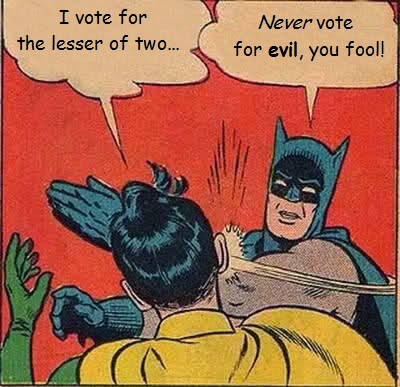
     In regards to voting, Catholics are taught that there are some policies which we just cannot reconcile with the common good, and so we cannot in good conscience vote for a candidate who supports those policies.  The policy that probably comes to your mind first is abortion.  In general, the Democratic Party in the U.S. is supportive of legalized abortion.  The Republican Party, in general, opposes laws which permit abortion.  No matter what other policies these two parties support, abortion just cannot be ignored when it comes time to cast your ballot.  It seems that, as a Catholic who regards all fetuses as human individuals, the decision is a no-brainer:  The common good is drastically opposed to the Democratic Party simply by that one token.  Yet, there is a grave problem in concluding that, therefore, one must vote Republican.  This strikes me as utterly narrow-minded and reminds me of the Jedi Council rallying the clone army under Chancellor Palpatine.*  It’s a trap.

     There is a fallacy named the “false dichotomy” whose definition helps us to understand the conundrum of which I speak.  A false dichotomy is a presentation of two points of view as if they were the only options, whereas others are available.  For example, “If you’re not a conservative, you’re a liberal” is a false dichotomy.  This only begins to express the whole problem of choosing a Republican over a Democrat. 

Who would you vote for?
Sure Lex Luthor is a bad guy, but he's great compared to Galactus!

     By now, you might be thinking “he’s alluding to third party candidates, but he might as well just not vote.”  It is sad but true, that to vote for somebody who is neither a Republican nor a Democrat is probably to throw one’s ballot into a three percent margin.  It seems that third party voters might as well stay home on Election Day.  My point here, though, is not a pragmatic one.  It is a moral one.  Catholics are not Utilitarians by principle; the consequences of an action do not make it good.  In fact, the principle by which most conscientious voters operate is to “choose the lesser of two evils,” in which case many consequences of the action would still be bad, just not as bad as the alternative.  Cut your losses, so to speak.

     But less evil is still evil.  Also, voting for a third party who would very likely not succeed is not equivalent to staying home and refusing to vote.  That is, action is still action, regardless of your success.  Is it better to try for the best possible option and fail or to compromise and succeed in securing evil?  If you still do not see how Republicans could be so bad, compared to everything Democrats stand for, have you ever considered the accusations against Republicans made by Democrats?  Have you ever considered that they might be true, regardless of the source’s own problems?  You might be thinking, “Sure, the GOP has its problems, but they’re not nearly as messed up as the Liberals’.”  This may be true, but it leads me to my main point.


     Here, I will define a fallacy which is based on the false dichotomy.  It is called “Satan’s Razor” and it is the mechanism by which a false dichotomy is created between two evils so that one is made to look good in contrast to the other.  Consider, for example, Communist Russia vs. Nazi Germany, using condoms vs. spreading HIV, or Godzilla vs. King Kong.  It is an insidious and clever lie to say that, because one stance is so evil, you are morally obliged to support its opposite.  The “razor” trick is ubiquitous, driving arguments from education (either feed the system or go stupid) to environmentalism (either abuse nature or don’t touch it).  As soon as you decide to support one side against the other, you have fallen into the trap.


     The morally conscious person is thoughtful with his principles and careful in his decisions.  Evil is nothing more than a defect; a flaw in something otherwise good.  The world is not a duality, a struggle between good and evil.  It is altogether good yet defective.  Instead of trying to fix one defect by increasing another, step back and think about what is really good and choose that.  If your efforts at a solution fail, at least you know that you did not contribute to the problem.

Friday, April 3, 2015

Why Easter is So Great

What makes a superhero great?  There are super powers, strong character traits, and origin stories for most superheroes, but these are not really what determine how great a superhero is.  Super-villains have super powers, strong character traits, and origin stories as well, but they are villains.  In fact, the difference between hero and villain is usually quite dualistic in most stories as it seems to matter only whose side one is on.  The question, however, is about greatness.  Super-villains could be great, but they are never called that (unless “great” is used as another word for “cool”), and there is one reason for this:  They never win.  Only superheroes win and only superheroes are great.  Each superhero is roughly as great as his deeds and the enemy he is able to overcome.  Beowulf is a great hero because he slew two fiends and a dragon.  James Bond is a great hero because he outwitted several evil masterminds and saved the world (i.e. the world‘s status quo).  Superman is a great hero because he defeated incredibly powerful enemies and saved the world from annihilation.  Among these examples, considering their stories alone, Superman is clearly the greatest.  If Superman, with all his powers, was never able to defeat any of his enemies, he would not be so great at all.

Beowulf vs Grendel

Iron Man vs Dr. Doom
(Super-battles have gotten flashier, it seems, but the struggle remains the same)

Let us consider a real live person; Jesus Christ, the God-man.  Being the Word of God, He created the universe.  This is indeed a mighty feat, but creation involved no enemy and no resistance.  As the Word-made-flesh, resistance began before He was even born.  From Herod’s preemptive threat of infanticide to the everyday work of carpentry, Jesus met problem after problem.  Yet everything the world saw Him do was no different from what men did before him.  His miracles were certainly incredible and He amassed an impressive following, but then one very problematic thing happened.  He died.  How could the Son of God die?  Why would He die?

There are two ways of understanding the fall of man and his salvation.  The first way is that, when the very first man committed the first sin, he offended God who is supremely good.  This offense incurred a supreme penalty.  There was no way any man could ever make up for what he had done.  The penalty of sin is death and we went on dying, always paying for our sin without actually paying it off.  When God himself became a man, he was sinless and so did not have to pay the penalty.  He paid it anyway, and died.  It was then that our debt was finally paid and we were freed.

The second way of understanding is that, when the first man committed the first sin, he gave himself up to the power of Satan.  We rejected God and made the Devil our master, and he is a cruel master indeed.  Man was not created to die, but death and decay are unavoidable when the creature is separated from his Creator.  God became a man so that he would be able to die.  He gave Himself up as a ransom for us.  When God the Creator suffered death, the power of death was broken.

Yet Jesus Christ’s death by itself was not enough to change our fate and reverse our corruption.  The story of man is pathetic:  Every man lives a brief life and then dies.  There is nothing he can do about it:  When death comes, his time is done.  If God had come down to earth as a man, lived a short life, and just died, then our story would be even more pathetic.  But even though He is a man, He is also God, and being the Eternal Creator, death did not last for Him.  On the third day, when the whole world had never been more dismal, Christ rose as a man more glorious than man had ever been.  Death was changed and life was given a new meaning.  Jesus Christ changed us:  Death does not mean the end anymore.  We will live on forever, body and soul.

Christ’s enemy was death itself.  His problem was man’s slavery.  No man could have imagined how death might be overcome, let alone think it even possible.  The answer for Jews was to work around death; to mark one’s grave, to be remembered, and to have plenty of children to carry on the name.  But God is great.  He destroyed death.  Life was an absurdity under the threat of death but He turned the threat of death into an absurdity.  The greatness of Jesus Christ surpasses even human imagination.  A greater hero cannot be thought.

Jesus Christ trampling Death and lifting Adam and Eve from their prison


Belief in the Resurrection implies other beliefs as well:

·         Jesus was completely human; else He would not really have died or risen. 
·         Jesus was completely God; else He could not have risen (not even angels can raise the dead) and if Jesus was merely human and God raised Him, then His resurrection would not have been any more special than Lazarus’.
·         We deserve to die.
·         Death is bad; else Christ’s victory over it would not have been that great.
·         Death is not that bad anymore because it will not last forever.
·         Our bodies are good; else God would not have cared about saving them.
·         The things our bodies are designed to do (like eating, drinking, and dancing) are good.
·         If there is any such thing as good news, Easter is good news, and everyone should hear it.

Saturday, March 7, 2015

The Lenten Lesson: We Are Incompetent

"To uproot sin and the evil that is so embedded in our sinning can
be done only by divine power, for it is impossible and outside man's
competence to uproot sin.  To struggle, yes, to continue to fight, to
inflict blows, and to receive setbacks is in your power.  To uproot,
however, belongs to God alone.  If you could have done it on your own,
what would have been the need for the coming of the Lord?  For just as
an eye cannot see without light, nor can one speak without a tongue,
nor hear without ears, nor walk without feet, nor carry on works without
hands, so you cannot be saved without Jesus nor enter into the
Kingdom of Heaven."  - St. Macarius


Nitrian Desert, Egypt, into which many saints ran

Abba Isidore said, "If you fast regularly, do not be inflated with pride, but if you think highly of yourself because of it, then you had better eat meat.  It is better for a man to eat meat than to be inflated with pride and to glorify himself."  - Sayings of the Desert Fathers

Thursday, December 11, 2014

Christmas Meditations, 2014


Ebenezer Scrooge’s biting criticism of Christmas was true on the visible level: “Christmas is a time for buying things.”

The Grinch stole every inane accessory of Christmas festivity in the attempt to cancel it.  The holiday, to him, seemed merely an excuse for noise making and frivolous rituals.

Ebenezer’s conversion was a climax built on the revelation of three distinct truths: His broken past, his hapless present, and his hopeless future.  His conversion was not directly influenced by Christmas themes or traditions; rather, Christmas afforded him the opportunity to reconcile with others.  He did so mainly by giving away what he had previously withheld.

The Grinch’s conversion was effected by a noise.  His preceding resentment centered around noise, but the new noise was different and unexpected.  What grew his heart was the realization that the bobbles and trinkets which he had stolen were accidental to the meaning of the celebration.

Neither “A Christmas Carol” nor “How the Grinch Stole Christmas” are Christ-centered stories; at least not palpably.  Both stories deal with a grouchy person who desires no part in the celebration but are nevertheless wooed into the most excellent participation.  Both stories are quite predictable.  Why?

In both stories, the villain protagonists would have been correct in their judgment if their estimation of Christmas had been correct.  They scorned what they saw and heard.  There was something hidden from them and their lack of knowing that thing made them villainous.  In one sense, it was through much labor that both characters were changed.  In another sense, it was something very simple and direct which changed them.  Scrooge saw his grave.  The Grinch heard a sound.

Dr. Seuss’ story is much simpler than Dickens’ (and this should be obvious, as it was written for children).  The moral of it is nonetheless important:  Trees and carols and presents are celebration enhancers.  They give expression to the meaning of the celebration.  The meaning itself should be enough inspiration to hold hands and sing out in joy.

Ebenezer’s journey to the light of Christmas is much subtler.  His vice is singular and apparent, but the means by which he is freed of his greed shows that he is a complicated character.  He is forgetful of his past and in denial of his social condition.  He not only fails to see the meaning of Christmas; he fails to see himself.  It is by seeing himself that he is changed.

Reality is much more complex than stories but, by simplifying reality into story-form, we can understand it better.  If Christmas does not inspire us to hold hands and sing out in joy, regardless of what gifts we were given, than we have problems.  Our problems are Scrooge’s problems.  Scrooge’s problems are the Grinch’s problems.  We perceive things but remain ignorant and in our ignorance we hold false attitudes towards those things.  This holds true not merely for stuff, but for ourselves also.  We forget who we are, where we came from, and where we are heading.  The truth is what changes us, if only we see it.

We are, each one of us, broken.  We live in uneasy company with the rest of the human race.  We are all, right now, losing time until death.

The trouble with us modern-day misers is that not only do we fail to see the facts, we fail to see their relation to Christmas.  The funny thing about misers, like the pre-repentant Scrooge, is that they neglect themselves in order to store up wealth:  The wealth they store up is used for no worldly comfort or what might be deemed frivolity.  What they sweat and strain to accumulate is no more than the feeling that they need not worry.  Whatever dire necessity they need, money will buy it.  In a way, we are all misers.  We neglect things we perceive as inane for the sake of feeling OK.  Well, the joke is on us.  We sell ourselves short only for the facts to remain:  We’re screw-ups, we’re alone, we’re going to die.

There is good news for those who will hear it.

We are, each one of us, broken.  We are not, as a species, broken.  We live in uneasy company with each other, but we are united in the prospect of peace.  We are all, right now, losing time until death, yet death is unnecessary.

What insane paradoxes!  I am broken but unbroken. My enemies are my friends.  I must die but I do not have to.  How could they make sense?  For Ebenezer, the answer must have been obvious. 

The moral of both stories, so often echoed by so many Christmas films, are often presented to be, “don’t be a stick in the mud.”  A child might accept such a moral without question and so, for lack of thoughtful adults, Christmas becomes just another “kid thing.”  Be jolly, give out lots of presents, and pretend that sometimes magic exists.  Seeing and hearing amount to things beginning to look a lot like Christmas and Silver Bells on every street corner.

“Noise, noise, noise…” says the Grinch.

The joy of Christmas which changed hardened hearts cannot have been Bing Crosby’s dulcet tones.  It must have been something a little more serious.

If there is a God, the facts are worse.  Not only are we broken, but there is someone we must answer to for all of the crappy things we have done.  Not only are we at war with the world, but God is watching it all go down.  Not only will we die, but God will be there… waiting.


Then comes Christmas.  God decides to become one of us.  He is born into the world as a flesh-and-blood human being; a messy, puny little baby.

God, master of the universe, is cold.